Thursday, April 16, 2015

What did I miss?

I'm back from my (too short) vacation.

I. More links!

Tom Hickey discusses one of my posts and has a good analogy:
The analogy of the "scissors" of supply and demand can be called upon to summarize [markets] albeit simplistically. As long as each blade is functioning as it should, e.g., sharp enough to do the work, and the scissors is working correctly as a system, with the blades operating in alignment, the mechanism cuts as it should. However, if one of the blades is not functioning as it should, .e.g., is dull, or the scissors is out of alignment, e.g., the fulcrum screw loosens, then the scissors no longer operates correctly and the cuts are either off or done happen at all, that is, the system fails.
The discussion in the comments is also very worthwhile (I added to it a bit), and illustrates the fact that there is no natural constituency to embrace (or in some cases even look at) the information transfer/information equilibrium framework in economics ... I'll go into more detail in a new post.

II. Linear models!


Paul Krugman has a post about linear models
nonlinear modeling all too easily turns into a game with no rules

I'd add that a lot of things turn macro into a game with no rules, including expectations and ad hoc microfoundations with representative agents. Part of the reason I started on this blog was to create a framework to help eliminate possibilities!

One of the articles that sparked Krugman's post is this one by Wolfgang Münchau, which I commented on, but am having trouble seeing the replies that I received on FT ... anyway, Münchau says:

The second is linearity — the idea of a straight-line relationship between events. Standard macroeconomic models are complex, and their system of equations is linear. But if you want to understand why the economy did well before 2007, why there was a break in 2008 and why the path of economic output never returned to its previous trajectory, one would require models that incorporate the notion of non-linearity, and even chaos.

The complexity of macroeconomics is frequently presented without proof. Simply because we know that an economy is made up of millions of complicated pieces (humans, firms, etc) and there hasn't been a linear model that's been unequivocally declared successful doesn't mean that macroeconomics is complex.

Here, for example, I've put together a linear model that describes this lack of return to the pre-2007 path without chaos. Just because you can't think of the linear model doesn't mean it doesn't exist!

In general, though, the problem with nonlinear models is that there isn't enough data to eliminate nonlinear models. Macro data is only a little bit informative for simple linear models -- anything more is like string theory: models without data to prove or disprove them.


I did like this follow up letter from Michael Kuczynski:
Macroeconomics is about economic systems moving around to live within their relatively fluid accounting constraints: the physics of gases may be a better starting point than rarefied requirements in mathematical proof.
III. Groupthink!


This is terrible news for dither.

Monday, April 13, 2015

Spring Break '15!

I am taking a short vacation (road trip!) and will be out of touch (and likely not answering comments) for the next few days. Here's an update of the Hypermind NGDP prediction market alongside the information equilibrium model (from this post) for your troubles ...


Sunday, April 12, 2015

Thinking positive is thinking different

This post is more for fun as I don't really have any specific evidence for any of the insights I present. However, I recently read Noah Smith's post on "growth mindsets" (the windmill Carol Dweck is tilting at) and had a thought based on the information equilibrium model. The original idea posits that people who think they can move beyond their circumstances typically do better.

In the information equilibrium model, economic growth comes from uncoordinated human activities -- coordination typically brings recessions. Another way to put this is that when people follow others (specifically, buy into the same pessimism), the result is a disastrous loss of "economic entropy".

Applying this to the individual, it recommends "breaking the rules", being a weirdo, being a freak. It is when we follow "what we're supposed to do" that our behavior becomes coordinated and entropy falls. All of us need to dither to explore the space of possibilities.

The thing is that growth mindsets, the idea that your abilities are not inborn, but can be achieved from hard work may actually have more to do with just having the courage and fortitude to be yourself. Being yourself is hard work and since yourself is the result of a random scrambling of your parents' DNA, being yourself is being different from other humans. You are born with a bit of dither and the growth mindset is really about keeping that dither -- not letting coordination capture you.

You hear the stories from CEO's that didn't take no for an answer and believed in themselves. They had the dither. But that sample suffers from selection bias, because the dither can lead you up or down. I'd say the classes of people contributing the most dither is represented among both CEO's and the homeless population.

So growth mindset is probably not the best term. I use the term dither here after Jaynes -- it captures what is going on a bit better. It's not believing in your potential; it's believing in your own way of doing things. That should be supported -- our societies should help those that think differently especially when they fail.


Tolstoy begins Anna Karenina with the great line: 
All happy families are alike; each unhappy family is unhappy in its own way
I'd like to borrow this, but maybe we should turn this on its head ...
All growth-minded people grow in their own way; those without this mindset are held back alike

Saturday, April 11, 2015

All models are wrong, but some are tedious


I've come across the "all models are wrong" trope that seems to make its way in economics more than other model-building fields a couple of times recently.

Stephen Williamson

Saying a macroeconomic model is wrong misses the point. These models are all wrong, in the sense that, with sufficiently good data in sufficiently large quantities, which has in some sense performed the right natural experiments for us, we can reject any model.
Lars Syll
Even though all theories are false, since they simplify, they may still possibly serve our pursuit of truth. But then they cannot be unrealistic or false in any way. The falsehood or unrealisticness has to be qualified.

I believe the original version of the quote is here:

George E. P. Box
Since all models are wrong the scientist cannot obtain a "correct" one by excessive elaboration. On the contrary following William of Occam he should seek an economical description of natural phenomena. Just as the ability to devise simple but evocative models is the signature of the great scientist so overelaboration and overparameterization is often the mark of mediocrity. (1976)
Box was a statistician (he passed away a couple years ago), and his concern was overfitting -- not a defense against where models fail or concern about the content of the theory. The original quote is more a statement about Occam's razor than a model failing an empirical test or not describing reality. All models are wrong, so don't go gold-plating a Rube Goldberg device. Not the more nihilistic: all models are wrong, so don't worry about empirical data or all models are wrong so worry about failures of realism.

Realism is in the eye of the beholder -- the original formulation of quantum mechanics (Heisenberg's matrix mechanics) was considered not only unrealistic but rather abstract with infinite dimensional matrices. It wasn't widely accepted until Schrodinger came up with his famous wave equation -- a differential equation following typical methodology of the time. It was a more realistic approach with things that looked like waves. You could take that as an analogy for economic models that have agents that look like humans. Additionally, I am sure the formulation of economics in terms of information equilibrium would be considered silly as well.

A real model contains its own limits so worrying about empirical data that goes against the model predictions misses the point. In the specification of the model, you should have some indication of the kinds of empirical data on which it will fail. As a scientist, you hope a model fails an empirical test. One of the most disappointing things about the Standard Model in physics is that it doesn't fail empirical tests [1]. When you have a model, the failures point out where there are things you don't understand.

In the light of the original meaning of "all models are wrong", we see in Willamson's quote that he points to places where more research ought to be done; it is not as he suggests a reason to not worry about where the model is wrong.

In the light of the original meaning of "all models are wrong", we see in Syll's quote that realism is an additional ad hoc constraint based on current (likely flawed) understanding; it is not as he suggests a path to success.

All models are wrong is properly taken as a rallying cry against tedium. Macroeconomists should not be adding variables and complications to their models because there simply isn't enough data to warrant doing so. Read Nate Silver on overfitting -- there are only about 200 quarterly observations of economic data in the post-war US economy where data is relatively good, which implies that a model should at most have about 10 parameters (some DSGE models have 40 parameters or more!). Noah Smith likes to say that macro data is uninformative. Really what that means is that economists have ignored Box: they shouldn't have so much overparameterization. With fewer parameters, the data isn't uninformative ... if you just have two parameters, the data is actually completely informative.

This tedium also manifests as overly complicated agent-based models. Sure, they get more realistic in Syll's sense, but they too overfit in Box's sense.

All models are wrong, but some are tedious.

Footnotes:

[1] There are some things the model doesn't include (neutrino oscillations, for example).

Information theory and economics, a primer

This lowly blog was honored with a link from Mark Thoma and a flood of new pageviews, so I thought I'd try my hand at a new summary of the basic ideas I'm presenting here.

The main idea is essentially to address the question of how much of economics can you describe by assuming as little as possible. The idea was sparked by one of the original drafts of this paper by Peter Fielitz and Guenter Borchardt where they stripped information theory to its bare essentials -- even abandoning the idea of bits for a concept they referred to as the natural information content. The result was a generic theory of information equilibrium between a pair of changing quantities that are made up of a very large number of constituent parts (importantly, what those parts are or how they behave is assumed to be unknown). 

Fielitz and Borchardt apply this framework to some problems in physics, including percolation and ideal gasses. I borrowed this information equilibrium framework and applied it to various problems in economics, coming up with some of the exact same models -- and some slightly different models -- as economists and comparing them to measured data with remarkable success for such a simple model.

One major divergence from mainstream economic approaches is the lack of assumptions about what it is that is mediating economic activity. You really don't need any economic agents, firms, households, rational expectations, or really any kind of human thought at all ... when markets are functioning properly. Market forces are like entropic forces in thermodynamics -- diffusion and osmosis are a couple of well known ones. Molecules in a gas don't know about their density at the other side of the room, but collectively they will distribute themselves to achieve an almost equal density across their container. People and prices can be described by the same information equilibrium framework that describes the behavior of molecules. The equilibrium states in this model are the ones with maximum entropy [1]. 

I think this actually solves a really tough philosophical problem. If humans have free will and don't behave perfectly rationally all the time, why does it seem that when markets are functioning properly, the mathematics of economics work so well  -- as if they were atoms in an ideal gas?

The physicist Eugene Wigner once referred to the "unreasonable effectiveness of mathematics in the natural sciences". One comment I frequently see out there on the economics blogs is the economics equivalent: economists' equations and models don't have anything that looks like a real human in them. Some economists actually defend this -- they say they don't need realistic humans or assumptions (microfoundations).

What this information equilibrium framework seems to say is that when markets are functioning properly, this is ok. To turn Tolstoy upside down, all functioning markets are alike; each market failure fails in its own way. Those functioning markets represent a common Platonic ideal -- something that can be described by mathematics. Interestingly, the information equilibrium framework also has some suggestions for how to approach the problem when markets fail, too! It's called non-ideal information transfer and it allows us not only to see markets that are functioning (those well-described by ideal information equilibrium), but point out ones that are failing. This also represents a divergence from mainstream -- markets aren't assumed to be functioning unless they can be shown to be functioning.

The basics of the framework come down to a couple of equations and what is effectively a supply and demand diagram -- which should be thought of as an entropic force diagram. We start with two economic aggregates we'll call A and B. If information is flowing from A to B (and there is no other source), then all we can say is that the information received by B is less than the information transmitted from A, or [2]:


We can use this (as Fielitz and Borchardt did) to generate a differential equation for a tiny fluctuation of A (we call dA) is received by B and causes a tiny fluctuation (we call dB):


This equation tells us how two economic aggregates A and B move with respect to each other. We define the derivative dA/dB to be an abstract price P. That is the general case -- it allows both ideal (equality aka information equilibrium) and non-ideal information transfer (the less than sign). If we look at ideal information equilibrium, we have:


I frequently use the notation P:A→B to describe this system (the arrow helps you remember that A is the information source in the case of non-ideal information transfer). Some may note that this is a minor generalization of the equation appearing in Irving Fisher's thesis and is also the simplest (interesting) model consistent with homogeneity of degree zero (to achieve e.g. long run neutrality).

There are two major cases of this last equation; in economics parlance, they are partial equilibrium and general equilibrium. Under partial equilibrium you effectively reconstruct a "supply and demand diagram" (or "B and A diagram"), which was the genesis of this blog. You have 1) A adjusting to changes faster than B or 2) B adjusting to changes faster than A. Confusingly, these represent a "B curve" and an "A curve", respectively. The key point is that if you have A and B in information equilibrium, you have an interaction that looks like a supply and demand diagram from economics -- additionally it can be used in a generalized way to e.g. derive the IS-LM model or the AD-AS model (the short run aggregate supply curve piece). Here is a generic diagram:


Under general equilibrium, you have A and B adjusting together. This results in a relationship where A ~ Bᵏ, and has been used here to describe long run aggregate supply in the AD-AS model, the quantity theory of money, interest rates (the interest rate is posited to be in information equilibrium with the price of money) and the Solow growth model. The general equilibrium solution also can be used to come up with all kinds of things in economics that are described by Cobb-Douglas functions. I am in the process of writing all this up to be submitted to a journal, and the draft of the section on macroeconomics includes these models.

Let's return to the major divergence from mainstream economics. While the behavior of supply and demand curves (letting A = demand and B = supply) is recovered by this model, it is agnostic about the details (the "microfoundations") of supply and demand. All that we assumed is that there are a lot of supply and a lot of demand.

So while mainstream economics would describe the increase in demand as the price falls (think of "Black Friday" shoppers rushing the stores for sale items) as a result of an incentive to consume ... that higher demand results from maximizing utility ... the information equilibrium view looks at it differently.

The information equilibrium view doesn't preclude utility maximization or incentives, it just renders those explanations unnecessary. There are simply more possible states with higher demand at lower prices than there are at higher prices. People aren't necessarily incentivized to consume more because of subsidies or low prices -- on average people end up in the state where they have consumed more through some unknown and possibly very complicated process.

Here's a list of some posts that give a feel for what I'm doing ...
  1. Some cool animations of supply and demand using the formalism above.
  2. The conditions under which maximum utility and maximum entropy give the same results.
  3. How utility, Joseph Stiglitz and Claude Shannon fit together.
  4. The information equilibrium model has what looks like a liquidity trap at low inflation, but looks like the quantity theory of money at high inflation. This post shows how those two different views are part of a continuum.
  5. Interest rates have several different forces acting at once: Fisher effect, liquidity effect, income effect. This is how they fit together.
  6. The Great Stagnation and its demand-side counterpart Secular Stagnation are really just properties of large economies with fiat currencies that have been relatively stable for awhile.

Here's some empirical data and projections for the US and Japan (and comparing performance with the NY Fed's DSGE model)
  1. http://informationtransfereconomics.blogspot.com/2015/03/most-recent-updates-to-core-cpi-and.html
  2. http://informationtransfereconomics.blogspot.com/2015/03/japan-inflation-update.html
  3. http://informationtransfereconomics.blogspot.com/2015/02/the-fed-seems-over-optimistic-on.html


Footnotes:

[1] You can think of this as how the model sees the efficient markets hypothesis (EMH). Prices are "maximally uninformative" about the state of firms, households, goods and money that lead to the observed price. This doesn't mean completely uninformative (as Robert Shiller has famously shown), but in general a price movement contains the least amount of information about the change in the underlying microeconomic state as it can.

[2] I am trying pictures instead of mathjax in this post to aid with display on RSS feeds.

Wednesday, April 8, 2015

Incentives are an entropic force

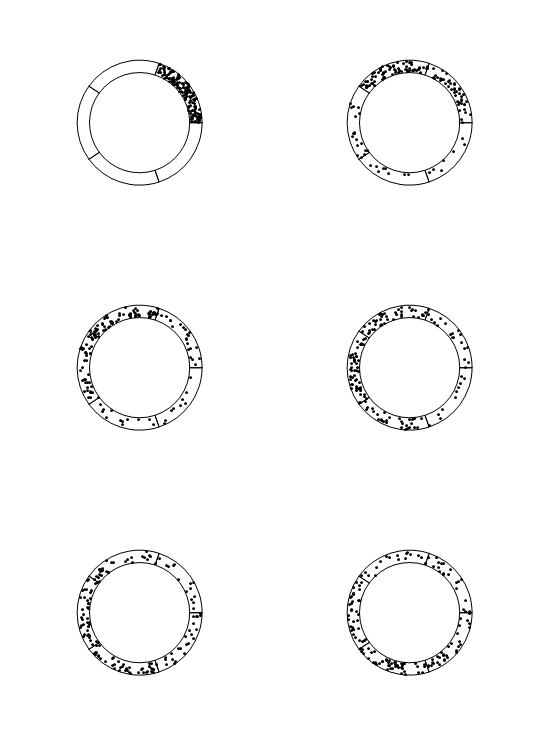
The points are not "incentivized" to diffuse themselves uniformly around the roundabout. They just happen to find the uniform distribution through random movements. 
The latest in my series of X is an entropic force, I'd like to propose the idea, meeting the mainstream of economics halfway, that incentives are an attempt at a microscopic description of an entropic force.

I recently re-read my post/discussion with commenter Jamie -- we both have qualms with the mainstream economic view that a fall in price causally leads to ("incentivizes") a rise in consumption. Jamie put it as an analogy with gasoline:
Which of the following statements is more accurate?

1) An increase in fuel [supplied] causes the car to travel further
2) An increase in the use of the car for travel causes an increase in the fuel [used].
And part of my response:
[The mainstream economic] view also says that an increase in the fuel supply (1) lowers its price and that makes more people buy more fuel. Now this idea is not only that more people can afford fuel at a lower price, or finally afford as much as they need, but that lowering the price incentivizes additional consumption ... like a moth to flame. Jamie and I both have a problem with this view. Lowering the gas price doesn't make me want to drive more. ... Despite my problem with this microeconomic view, I still think it gets the result correct, just not for the right reasons. The problem with the micro viewpoint in the previous paragraph is that is tries to assign a microeconomic explanation for an entropic force.
By "gets the result correct" I effectively mean incentives save the phenomena of supply and demand, like how Calvo pricing saves the phenomena of nominal rigidity. Saving the phenomena is a phrase used to contrast with models that offer explanations. Calvo pricing and incentives do no explain economic behavior, they save the observed economic phenomena.

We observe the fact that lowering the price on e.g. bacon generally tends to increase its consumption. Economics does not teach that this effect is dominated by people who are now able to afford the bacon -- in the model, everyone is able to afford the bacon -- their utility is maximized by doing something else with the money.

That makes it weird for people like Jamie and me. At the very least it should be weird for Jews and Muslims who don't eat bacon on religious grounds -- economists are telling them that they would consume more bacon if the price is reduced, ceteris paribus.

It's weird on the supply side too. Shannon may want to be a doctor, but if the price of bacon rises, economists are telling her she now wants to go into pig farming or pork belly futures a little bit more than she did before.

All of this strikes most ordinary people who don't think of life in terms of the pecuniary incentives as freaky (here's a good example). Economists and homo economicus seem like rational aliens. I'm sure that's where the particular non-intuitive explanations in the Freakonomics vein derive their pageviews. It's also behind a phrase I've seen: "thinking like an economist". It's also probably why there are so many heterodox views out there.

The entropic force view of supply and demand dispenses with this freakiness.

Instead of individuals feeling drawn to buying more bacon because the price fell, on average the total amount of bacon consumed per person rises through millions of individual decisions because that is the most likely state among millions of people. In the entropic force view, this consumption increase doesn't even have to happen! It just happens on average -- if you reset and re-ran the world (like a Monte Carlo simulation), you'd get a different result each time. On average, you get an increase, but fluctuations for N agents are on the order of ~ 1/√N. Jamie and I can't feel compelled to consume more gas at a lower price in the realized world because we in fact aren't compelled to consume more gas in most realizations of the world.

Shannon can't feel pulled into pig farming because she doesn't go into pig farming in most re-runs of the world economy. Someone may consume more gas or go into pig farming (or more likely current pig farmers will produce more bacon), but a story can't be told for a representative agent because it doesn't apply to everyone.

No single atom is compelled to diffuse to a region of lower density. They move around randomly, occasionally colliding with the walls of the container or each other. Collectively, there is an entropic force driving the atoms in a gas to an equal (maximum entropy) distribution over the container. And since there are ~ 10^23 atoms in a macroscopic gas sample, the fluctuations around an equal density are ~ 0.0000000003 %.

Economic systems have fewer agents so have much larger fluctuations than a typical macroscopic atomic system. In physics, we'd probably call a macro-economy a meso-economy instead.

Economists came up with the idea of incentives to figure out why people would be pulled into pig farming or driving further ... or how supply can create its own demand [1] ... at the microeconomic level. When the price falls (or a good is subsidized), people are "incentivized" to consume more than they would have otherwise in order to maximize their utility. We're all greedy algorithms sucking up utility however we can.

And to a great extent, models of incentives work at effectively describing the situation after a price drop or a subsidy. Some people really must be buying less bacon when the price rises because overall consumption is observed to decrease when the price rises. Averaging that decrease in consumption across everyone, you have everyone decreasing their consumption a little bit -- incentivized by the price rise.

But it also leads to the weird idea that subsidized health care will lead to people to have more surgeries even if they could have afforded the extra surgeries before the subsidy. Or that lower gas prices make people drive more (I can assure you I do not want to drive around my hometown any more than I have to). Some budget constrained people do drive more because they can afford it when the price falls; some people do get surgeries because they can afford them after the subsidy.

In economics, these would be treated as an exception to incentives (i.e. a more detailed model of incentives) with an ad hoc model for some goods [2].

The entropic approach unifies these the successes and failures of incentives into a single model -- surgeries and driving may be more like a Fermi-Dirac distribution (lower maximum occupation numbers) than a Maxwell-Boltzman distribution. You have people getting the surgeries deemed medically necessary (and no more) or driving as far as they can given the constraints of work and vacation ... and you still have people rushing into the malls on "Black Friday" for the sales. They're all maximum entropy solutions, just over different sets of available states.

Footnotes:

[1] Say's law in mainstream macroeconomics isn't considered true (partially because of the existence of money), but one description of the role of a central bank is to make Say's law true in practice via monetary policy.

[2] Footnote added 4/16/2015: Per LAL in comments below, this would be the inclusion of satiation points. However, that breaks the fundamental theorem of welfare economics -- that market outcomes (Walrasian equilibrium) are Pareto efficient -- which requires local non-satiation. This is interesting because it kicks out one of the legs in favor of utility in the first place: to have something that can be maximized defining a Pareto efficient allocation. If we're not maximizing utility, then why worry about the utility maximizing solution? Why not work with the entropy maximizing solution?

Prediction markets, trends and models

New NGDP numbers are going to come out soon (at the end of April) and so I've updated this prediction and put the Hypermind predictions (linked at Scott Sumner's blog) on my prediction. Lo and behold there really will be no way to distinguish among the prediction market (black line segments), the post-recession trend (solid red) the long term trend (dashed red) and the information equilibrium model (gray):


My view of prediction markets is here (they seem to only be asynchronous polls).

PS Scott Sumner says that the prediction market believes the Great Stagnation. Couldn't we say the market believes the information equilibrium model?

Tuesday, April 7, 2015

Mark Thoma, information equilibrium is the model you're looking for

I just read Mark Thoma's The Fiscal Times piece that he referred to as In Search of Better Macroeconomic Models at his own link. It seemed like every other line I was inserting a mental "which you can solve with information equilibrium" ... so in this post I'm going to excerpt with commentary. Let's begin.
... we know that when [there is unemployment], we can make everyone better off by moving to the equilibrium point. So why would firms or workers negotiate such an outcome? Why would both sides, in essence, leave money on the table?
Wage stickiness is probably an entropic force. Nothing stops individuals from taking wage cuts (i.e. being 'rational'), but it is overwhelmingly unlikely that hundreds of thousands of individuals simultaneously take this same rational choice. You can imagine this as it being unlikely that their individual financial histories are lined up at that moment. See: Wage stickiness is an entropic force
It turns out that attempting to add up individual equations to obtain aggregate, macroeconomic relationships creates all sorts of difficulties that are difficult or impossible to overcome.
In the information equilibrium approach, you make minimal assumptions about these individual equations -- in a sense only assuming that they can be added up. See: Entropy and microfoundations
Unfortunately, the representative agent approach is unsuited for studying behavior in financial markets. The problem is that there is no way for a single representative household to trade stocks and bonds with itself based upon different forecasts of future economic conditions
In the information equilibrium picture there is a detailed balance of financial transactions going back and forth in either direction. When agents change their decisions based on e.g. their perceptions of economic conditions, the millions of decisions add up to an imbalance -- a net flow in one direction or another. See: Towards ADM equilibrium and What does the AD-AS model mean?
The older, aggregate style models seem to do a much better job of predicting macroeconomic outcomes – as I explained in my last column, during the crisis they behaved admirably – but it is never clear if the equations are consistent with rational maximizing behavior.
Under some conditions, utility maximization and entropy maximization can be the same thing (actually, since utility is unobservable, we can always redefine it to make the utility and entropy maximizing equilibrium identical). See: Utility in an information equilibrium model
For some questions, the aggregate approach is best despite the criticism it has received in recent years from those using modern models, and we shouldn't think of it as going backwards if we adopt this approach when it provides simple, fast, and accurate answers to our questions.
The great thing about information equilibrium for Mark Thoma is that it recovers a lot of the old models like AD-AS, IS-LM, etc. In fact the information equilibrium approach justifies the diagrammatic approaches because those diagrams are basically entropic force diagrams for market forces. See: What does the AD-AS model mean?Why focus on supply and demand? and Information equilibrium: macroeconomics

Monday, April 6, 2015

Solving the dark matter problem


I saw this in three places (Robin Hanson, Tyler Cowen, and Scott Sumner) over the weekend. The basic idea is that the market capitalization and the "book value" of companies in stock indicies has wildly diverged. Hanson refers to the difference as "dark matter" and says that companies are now 5/6ths "dark matter".

This would be confusing if you take the conventional economic viewpoint that two things in equilibrium (market cap and book value) are simply proportional to each other. Let's define $M$ to be the market capitalization and $B$ to be some number of physical world "book widgets" (parcels of land, semiconductor fabs, employees, etc). The conventional view would have you surmise that:

$$
M = c B
$$

where $c$ is some constant that represents some price per book widget.

However, if we take market capitalization and book widgets to only be in information equilibrium with each other, I(M) = I(B), we can get a more complicated relationship [1]:

$$
p = \frac{dM}{dB} = k \; \frac{M}{B}
$$

where $p$ is the stock price. Which, if we solve the differential equation, says that

$$
M = \alpha \left( \frac{B}{B_{0}} \right)^{k}
$$

$$
p = \alpha k \left( \frac{B}{B_{0}} \right)^{k - 1}
$$

If $k$ is large, then one would expect a big difference between $M \sim B$ and $M \sim B^{k}$. That means that $k$ seems to be large, leading to lots of "dark matter", and that the fraction of dark matter should get larger over time since that fraction would be

$$
\frac{M}{c B} =  \alpha \frac{B_{0}}{c} \left( \frac{B}{B_{0}} \right)^{k - 1} = \frac{B_{0}}{c k} p
$$

... i.e. proportional to the stock price [2].

There is one thing missing here, what about slowly growing companies (or failing ones with falling stock prices)?

That's where the market indices and public exchanges come in. Market indices and publicly traded stocks select for large companies, good performing companies, and companies with rising stock prices. If a company's stock falls continuously for a significant period of time, they usually get de-listed. In a sense, market indices select for high $k$, since those are the companies that would grow fastest or be the biggest.

Now you may accuse me of just re-labeling dark matter as this $k$ factor ... and that is kind of true! But $k$ should change over the lifetime of a company, high at first in its fast growth start-up phase, then lower over time. Restructuring or getting into new lines of business could cause $k$ to increase temporarily, but entropy wins in the end (doesn't it always). Any company that goes near $k = 1$ would be ripe for a hostile take-over or simply split-up and sold for its book widgets.

We may not be able to predict what $k$ is for a particular company at a given time, but the general behavior tells us that when we look at market indices and see more and more "dark matter" we're actually just seeing selection bias among a larger and larger pool as the economy grows in size.

That is to say all companies have dark matter! But they may easily have as much as they always did and all we're seeing is selection bias.

Footnotes:

[1] Think of market capitalization as 'aggregate demand' for a company.

[2] Interestingly, the number of stock units $M/p = B/(k B_{0})$ gives us an idea of the number of book widgets.

Sunday, April 5, 2015

What does the AD-AS model mean?


Cameron Murray has a new post up about logical fallacies and contradictions involved in setting up the AD-AS model in macroeconomics. I personally like the AD-AS model as a toy model of how an economy works. It misses out on a bunch of details, but I think it forms a fine basis from which to depart with more detailed model.

The focus of the Murray's post is the fallacy of composition, which I've seen used as a rhetorical device in many instances (the sum of government spending effects on local spending doesn't mean there is an aggregate effect, or prudent increased saving by individuals isn't prudent for the overall economic situation in the paradox of thrift). As a physicist, I've always thought of it as a strange rhetorical device. In physics we have large numbers of examples where the fallacy applies, but it is never used. I think the reason it is never used is that in general there is a specific effect at work and we'd refer to that effect instead of the "fallacy of composition" -- quark confinement, entropic forces, emergent dimensions in string theory, pretty much all of materials science.

I think the fallacy of composition would better be called the warning of composition -- an idea that warns you of:
  • Effects that might go away at the macro scale (an example is the SMD theorem, and on this blog most of the details of how economic agents operate)
  • Effects that might not exist at the micro scale, but do at the macro scale ("entropic forces", emergent properties, and on this blog nominal rigidity)
The warning of composition can help prevent you from making unwarranted jumps in logic. But sometimes those jumps are warranted (or you have explicit machinery for adding the effects together).

So let's look at the AD-AS model in the information equilibrium framework. It essentially lives entirely on the macro scale, so there isn't any fallacy of composition. We instead have failures of information equilibrium, exceptions and other micro effects.

The basic set up starts with the main information equilbrium condition for the information in the aggregate demand in information equilibrium with aggregate supply I(AD) = I(AS), so that we have the differential equation:

$$
P = \frac{dAD}{dAS} = k \; \frac{AD}{AS}
$$

Note that this is just the minimal (interesting) differential equation consistent with long run neutrality (homogeneity of degree zero in supply and demand functions). There are three solutions we look at here:

  1. Both AD and AS vary (general equilibrium; for example in a growth model)
  2. AD is held constant (partial equilibrium; the system is in contact with a "demand bath" -- a demand curve)
  3. AS is held constant (partial equilibrium; the system is in contact with a "supply bath" -- a supply curve)
The solution to the first case is given by (you can ignore the angle brackets -- they represent expectation values in an ensemble of agents [1])

$$
\langle AD \rangle = a_{0} \left( \frac{\langle AS \rangle}{s_{0}}\right)^{k}
$$
$$
P = a_{0} k \left( \frac{\langle AS \rangle}{s_{0}}\right)^{k - 1}
$$


The other two solutions are family of supply and demand curves (where we define $\Delta AS = AS - s_{0}$ and $\Delta AD = AD - a_{0}$ parameterized by $\beta$ and $\alpha$ respectively so that

$$
P = \frac{a_{0}}{k \beta} \exp \left( + \frac{\Delta AS}{\beta k} \right)
$$
$$
P = \frac{\alpha}{k s_{0}} \exp \left( - k \frac{\Delta AD}{\alpha} \right)
$$

Shifts in the supply and demand curves are shifts in $\beta$ and $\alpha$. Here are the resulting supply and demand diagrams (there are more details about this derivation here, the expectation values $\langle AD \rangle$ and $\langle AS \rangle$ parameterize the location along the supply and demand curves, respectively and drop out in the price functions above):


So now let's try and address some of Cameron Murray's problems with AD-AS ... 


Let's start with his point 1:
The fallacy at play here is that there is an aggregate price level. As we saw in Chapter 8 on Inflation, price levels are not absolute but relative to some base year. In the economy as a whole there is no external price from which to determine a price level. Hence the idea of an economy-wide price level is in a given time period is a fallacy. 

Often the AD-AS model is interpreted as showing Real GDP related to the rate of inflation in a period (not the level, but the rate of change of price levels relative to a base year). This overcomes the fallacy of composition because it compares the price level with last year’s price level, but contradicts earlier discussions about anticipated vs unanticipated inflation. If inflation is anticipated at any reasonable level then there should be no economic effect, and hence no relationship (no curve, or a vertical line at best).

A really good way to clearly see some of the properties of the information equilibrium version of the AD-AS model is to take $k = 1$. This is just a parameter, so we can set it to whatever we'd like and what is left should still express the fundamental properties of the model (as opposed to parameter dependent ones). In that case we have (I'll drop the angle brackets for now [1]):


$$
\text{(1a) }\; AD = a_{0} \frac{ AS}{s_{0}}
$$
$$
\text{(1b) }\; P = a_{0}
$$

Note that $P$ is a constant. The AD-AS model has nothing to do with trend inflation or the absolute price level. The absolute (level) version of the model is trivial [2]. If $k > 1$ then all that adds is a trend growth and trend inflation. 

All of the real action is in the partial equilibrium (supply and demand curves) which do not materially change when $k = 1$

$$
\text{(2a) }\; P = \frac{a_{0}}{\beta} \exp \left( + \frac{\Delta AS}{\beta} \right)
$$
$$
\text{(2b) }\; P = \frac{\alpha}{s_{0}} \exp \left( - \frac{\Delta AD}{\alpha} \right)
$$

This prepares us for Murray's point 2:


As income rises consumption will rise, and as income falls, consumption will fall (p269) ... In aggregate the total consumption (or demand) in the economy is equal to the total incomes in the economy be definition, since someone’s consumption is somebody else’s income. This sentence, allowing from proper aggregation that avoids the fallacy of composition, merely says that aggregate incomes and consumption just rise and fall together since they are equal at any point in time by definition. 


There is a difference between a rise in a price in general equilibrium Eqs. (1a, b) and a rise in the price in partial equilibrium Eqs. (2a, b). The former case (which is the one referred to in the quote from p269) is essentially a change in $a_{0}$ in equation (1b) or trend inflation if $k > 1$. 


Murray's subsequent comments involve combining the AD-AS model with some model of interest rates, beyond the scope of this one post (here's an example in the IS-LM model). He does at the top of his post say:
[No economics professors] could explain what the concept of the price level in the aggregate even is, nor what mechanism was meant to be at play in generating the relationship between price level and output.

Within the information equilibrium version of the AD-AS model we have an answer. But it completely ignores the "warning" of composition. The AD-AS model at its heart is a simple aggregation of millions of supply and demand diagrams for each product in a large economy. The price level in aggregate is simply the sum of all prices and the mechanism for the relationship between $P$, $AD$ and $AS$ is just supply and demand operating on the grand scale. If there is more demand for aggregate output than there is aggregate output that exists, prices in general will rise. If there is a fall in demand, prices in general will fall. 

It's a simple model! The mechanism is the same as supply and demand ... now there may be some issues with the reasoning behind that ... [3]


Update 4/6/2015

Cameron Murray was right that the AD-AS model presented above doesn't directly address the fallacy of composition; I commented back on his blog and I've attached the comment below for reference here ...

I guess I wrote up the AD-AS model post a bit too quickly and really only addressed the fallacy of composition with a single sentence: 
"[the model] essentially lives entirely on the macro scale, so there isn't any fallacy of composition." 
That is to say the model makes no specific assumptions about the details of household or firm behavior. You could interpret that in a couple of ways, though 
1. Micro behavior is approximately random
2. Micro behavior is so complex it appears random
3. Any detailed micro behavior is subject to the fallacy of composition -- after being filtered through the aggregation process, all that's left looks random 
'Random' here is being used in the thermodynamics sense -- I'm not saying households are irrational, increasing or decreasing their holdings of liquid assets at random month to month. Each atom in a gas obeys very strict physical laws like momentum and energy conservation. Likewise each economic agent could have some kind of deterministic micro behavior. Just like we don't know the history of collisions for an atom in a gas, we don't know the history of financial transactions of one household. Any given household will be increasing or decreasing its holdings of liquid assets at any given time because of that history. Most of the time these are in "detailed balance": households increasing equals households decreasing. 
If e.g. inflation falls, there could be a tendency on average for those holdings to increase (based on millions of household decisions consistent with millions of financial histories) due to a small imbalance, aggregated up to the macro level. However, any individual household wouldn't point to the falling inflation. And it's not even true that inflation is influencing household behavior -- falling inflation is simply the most likely macro state where liquid asset holdings are increasing (in the AD-AS model). Since there are millions of households, the law of large numbers kicks in. 
In that way, the AD-AS model I present at the link is a macro-only model. Higher inflation doesn't cause individual households to increase their demand for iPads. The higher inflation macro state is consistent (in the AD-AS model) with a macro state in which more iPads are being consumed.
Update II 4/6/2105 

I should also add that the general equilibrium solution -- #1 in the list at the top and equations (1a,b) -- essentially defines the "long run aggregate supply" (LRAS) curve while equation (2a) defines the "short run aggregate supply" (SRAS) curve, so the full diagram is:


Footnotes

[1] The angle brackets are a bit like how in thermodynamics one takes volume to be $V = \langle V \rangle$. Volume doesn't exist for an individual atom, but only makes sense as a property of an ensemble of atoms. The same goes for demand in the information equilibrium model -- it is not a property of an individual agent, but an ensemble of agents.

[2] If we say AS is made of components, like capital and labor, then it gets a bit more interesting and you arrive at the Cobb-Douglas production function in the Solow growth model.


[3] Supply and demand seem to be entropic forces (and supply and demand diagrams are entropic force diagrams) that may defy a microscopic description. For example, here's one way to get something that looks like utility but really is just random behavior.