Monday, May 7, 2018

Recessions and special snowflakes

The 1991, 2001, and 2008 recessions.

My issues with Dirk Bezemer's academic credibility seem to have nudged the Post Keynesian hornets' nest such that they seemed to assume I was attacking Post Keynesianism in general, which I gladly took on because one thing that I really do dislike is cult-like adherence to ideology regardless of what that ideology is. But first let me clarify a few things.

  • My own work here would probably best qualify as Marxist econophysics if we're putting labels on things in the sense that Marx today would probably be a neoclassical economist but think of the results as sucky and doomed to end in revolution. I'm uncertain about the inevitability revolution, so in my own work I suggest a lot of neoclassical economics is often a fine description of reality empirically but the results are sucky and unavoidable.
  • I really don't have any problems with many thinkers associated with Post-Keynesianism (Robinson, Minksy, Godley & Lavoie), but rather the fans that try to turn a bunch of disparate ideas into a "school" and make claims about these beatified economists they likely would not themselves. Various Post Keynesian supporters have told me that Post Keynesianism is well-defined and then proceeded to give me a novel set of commandments not listed by the previous person to do so. The definition I'm going by is Marc Lavoie's [1] because it is the only one that seems to be a stable kernel.
  • Monetarism at least has hyperinflation as an empirical success; Post Keynesian empirical work is limited at best (and the right data might not even be available). As I suggested to Jo Michell on Twitter, it feels like a band that has logos and merch designs before they've played any gigs.

If you want to argue with these things, please do note that I am most convinced by theoretical curves passing through data points or their point-estimate equivalents.

Now that is out of the way, one of the other things I noticed in the trolling, I mean, discussion is that people have a lot of different stories about how different recessions happen. These stories are told with the kind of conviction that looks awkward in the context of several people telling different stories starring the same heroes and the same villains (or with the heroes and villains interchanged). The film Rashomon comes to mind. On the other hand Post Keynesian economics explains every recession, but every recession is a special snowflake with entirely different causes.

Now this isn't just a Post-Keynesian phenomenon, but is in fact extremely common from random men mansplaining the early 90s recession to economists giving what they think are unassailable descriptions of the Volcker Fed causing the 1980s recessions. The diversity of post hoc ergo propter hoc arguments identifying the cause of recessions is more likely a result of the fact that most of the time series take a turn for the bad in a recession weighted by politics [pdf].

This suggests an interesting hypothesis. Maybe the 90s recession was caused by the preceding saving and loan crisis, the 2000s recession by the dot-com bust, and the 2008 recession by the housing crisis ... but what if instead these recessions are caused by some other factor and the recession process simply undermines everything (with the news reporting on the largest collection of things that were undermined)? Like an avalanche taking everything with it, the oncoming recession undermines every source of growth if they are a bubble or not. Sure, this is just basic common sense in causal analysis: you observe X and Y seem to cause Z, but what if W causes X and Y? But I think it might be even more helpful in this case.

Now I'm not saying housing bubbles are a good thing as long as there's no recession, and it seems very likely the size of the US housing market boom contributed to the magnitude of the 2008 recession. Economic bubbles and even sustainable booms likely add snow to the eventual avalanche. But the idea that recessions pop bubbles (instead of popping bubbles causing recessions) helps us understand a few things:

  • There is as yet no consensus in economic theory as to what a recession is, and even the disparate theories individually do not describe recessions with a great deal of empirical accuracy
  • Several so-called housing bubbles (including many places in the US and in Norway) seem to have picked right back up and continued in the aftermath of the Great Recession
  • Australia seems to be having a continuing housing boom/bubble, but no recession meant no crisis
  • The theories of collapsing over-investment often are independent of what the over-investment is being invested in (e.g. over-investment in infrastructure, tulip bulbs, dot-com stocks, places to live, industry stocks). 

That last point is one of the more curious aspects. You would imagine over-investment in housing (employing millions of people and producing real assets) would be different than over-investment in random internet start-ups (employing only thousands of people and producing intellectual property). However, the two boom-bust cycles only differed by roughly a factor of 2 in scale. You could replace "housing" with "credit card debt", "corporate bonds", or "student loans" and the bubble analysis would be mostly unchanged. In fact, there are many stories ongoing today (the most common being a stock/asset bubble) that would likely be seen in the aftermath of a future recession as evidence that over-investment caused it [2]. The "dot com" or "[Dow Jones] industrial" adjectives in the market crashes are just adjectives -- not critical components of the analysis. Now this could be evidence that financial crises are universal processes, but another possible interpretation is that there's a universal process behind them — a recession cutting the booms off. An analogy:
Even though a drunk at a bar is being cut-off by last call, last call wasn't caused by how drunk he is. His drinking binge was ended by a separate process. 
I am not in any way saying this is conclusive evidence [3], but rather serves best as a palliative for confirmation bias and post hoc ergo propter hoc reasoning. Maybe each recession is a special, unique snowflake: the result of a process that starts when air with water in it reaches a certain temperature.

...

Footnotes:

[1] Marc Lavoie (pdf, H/T Jo Michell):

Essential Post-Keynesian Features (Lavoie 2006)

• The principle of effective demand
(demand-led economies)
– Both in the short and in the long run

• The importance and irreversibility of time
– Historical time
– Dynamics, the traverse
– Path dependence, multiple equilibria
– Tracking financial stocks

[2] And whoever wrote those analyses would be lauded as the ones that predicted the crisis.

[3] For one: what the @#&* is this underlying process? I am sympathetic to it being a more social process than economic one, but I'm really not convinced by anything at this point.

Friday, May 4, 2018

Robots versus shipping containers


There is an ongoing debate as to whether automation or trade is responsible for the decline in manufacturing jobs in the US (or as I put it, robots versus shipping containers); a new article in Quartz makes the case that it's the latter. Leaving aside the question of whether it is good or bad for a country to lose manufacturing jobs (and another country gain them), I decided to try and look at this with the dynamic information equilibrium model to answer the question: robots, or shipping containers?

I used the ratio of manufacturing jobs to all jobs (MANEMP over PAYEMS on FRED), and tried to see if a single shock can explain the data. The result is plausible (I ignored the WWII build-up and decline):


Click to enlarge. This model has one shock centered on 1989.6 with a width of about 40 years (1969 to 2009). However, the empirical accuracy can be improved by adding a second shock:


These shocks are centered on 1981.6 and 2004.1 with widths of 40 and 9 years respectively. We have overlapping eras from 1962 to 2002 and 1995 to 2014 that would could tentatively label the robot shock and the shipping container shock. It is actually surprising that we can resolve two shocks (they could plausibly merge together into a single shock like the model above). I am not sure of the source, but an article here says that GM introduced its first industrial robot prototypes in 1961. Here is an Atlantic article about industrial robots and their origins that sources the 1961 date to here. There's some more information here with an early appearance on the Tonight Show in 1966:


The shipping container shock appears in the data on the maximum size of shipping container vessels, which starts to take off after 1995:


It's not that the size of the vessels was driving shipping, but more likely the other way around. In the aftermath of the end of the cold war, globalization began as barriers to trade came down (and the free market ideology behind it flourished).

The relative size of the two shocks is about 3 to 1 (i.e. it was mostly robots), but the modern politics behind a move toward increasing trade barriers and tariffs is more likely due to the more recent shock. The robots had already taken over the US in the early 2000s. The shipping container shock came to manufacturing that was more difficult to automate. However, that shock is also mostly over in the US.

So the story behind manufacturing jobs in the US looks like it was first decimated by robots, but then finished off by shipping containers.

Down, down, down: the unemployment rate


The unemployment rate showed its first fall in a few months, to 3.9% from 4.1%. Overall, the forecasts (model described here) from the beginning of 2017 (!) are doing fine almost one and a half years out. At least my forecasts. The historical forecasts from the FOMC and FRBSF look more and more like they're just playing catch-up with reality (and the Minneapolis Fed remains biased high). Eyeballing it, the lifetime of accuracy from the FRBSF forecast is about four to six months.


Thursday, May 3, 2018

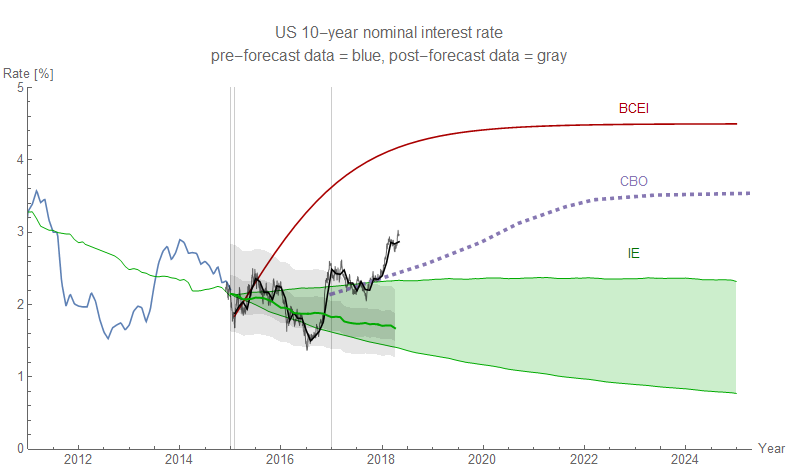
Three sigma deviation in the 10-year rate


So I'm continuing to track the 10-year interest rate forecast from nearly 3 years ago. While the forecast did well before the 2016 election, today we're above a 3-sigma deviation from the estimated model error (the 99.9% percentile, or 1 in 1000). Of course with nearly 800 data points, we might expect to see at least *one* 3-sigma event. A similar deviation happened in the early 80s (Sep 1981 to Jun 1982) making this the second period of such a deviation.

This is extremely interesting because that time period represents exactly the time period where the Fed raised the discount rate to its maximum level, which (according to the standard narrative) kicked off the the second dip of the double-dip recession. However, like in the 80s, there appear to be signs of an upcoming recession in other data that might be a leading indicator.

I will admit it is speculative, but given the timing/timeline of the previous 3-sigma event it may become clear the US is in recession in the next 6 months (NBER won't officially declare it until a few quarters later).

Now you might wonder how raising interest rates to only about 2% could trigger a recession today in the same way raising interest rates to 14% did in the 80s. I admit I don't have a good answer to this except to say increasing labor force participation in the 80s probably provided a sufficient tailwind that Fed had to do do much more.

In any case, this makes for an excellent test of the model. Interest rates should come back down in the near term (about 6 months). A possible mechanism to bring them down is recession. The longer they stay at the 99.9% of their range or further, the more likely the model can be rejected.

Here's a zoomed in and non-log scale version of the graph at the top of the page (the green band was the forecast of the green line while the gray bands represent 50% and 90% confidence limits on the model error from the observed path):


Letter to Dirk Bezemer

Update 07 May 2018: Professor Bezemer has responded via email; my original post appears below.

Dr Smith,

I received your questions. You might have waited for the answer, which is below, before putting them on https://informationtransfereconomics.blogspot.nl/2018/05/letter-to-dirk-bezemer.html.  Could you please post this answer there; I do not not have the necessary profile credentials. 

My work on this topic appeared in two published articles in the Journal of Economic Issues and in Accounting, Organizations and Society, which I will refer to as the JEI article and the AOS article. It appears you never saw the AOS article. They are available at http://www.economicsofcreditanddebt.org/my-research/

I summarized the projections and warnings of twelve economists in the JEI article in a table. Because it is a table, I slightly condensed some of their quotes, but I quote them in full in the texts. In fairness to your concerns, I agree that the quotation marks should not have been in the table since I shortened their text, hence it is not their literal text. If you read the two articles, you will see their views are represented fairly. I checked in 2009 with all those still alive. 

The “Godley and others in April 2007” source is indeed "The US Economy: What's Next" by Godley et al (2007). This article is not in the reference list since I did not include that reference in the article text (that is, I wrote ‘Godley and others in April 2007 predicted’ instead of ‘Godley et al (2007) in April 2007 predicted’). I agree that isn’t helpful if you want to know where Godley and others in April 2007 wrote what they did. But I do not imply that the quote should be found in one of the later sources that I do give, as you imply.

The first quote in the table is from Godley and Zezza’s (2006) Debt and Lending: A Cri de Coeur, as I write in the text of the AOs article. You should read the paragraph where I write “When house prices started to fall…” and onwards to see my full discussion of Godley and Zezza’s (2006) projection, and compare this to the text in the table to see that I quote fairly.

Godley’s quote cannot be construed as a prediction of the global financial crisis. Godley foresaw the US recession but not the global crisis, to my knowledge. I never claimed he did.

There is no problem in the fact that Godley et al note the collapse is already underway. That does not detract from their correct projection of consequences of the crisis that was underway, which at that time many still saw as a bad but local housing market crisis. It is the perception of the macro consequences that makes their analysis remarkable, don’t you think?

I cite and discuss Michael Hudson’s full quote in my AOS article. Read the paragraph starting “Hudson wrote …”.

Steve Keen’s projection (like Godley’s) was made on the assumption of unchanged policy. Australia however implemented a housing credit expansion program and suffered a major growth slowdown which fell only just short of a technical recession (one quarter negative growth, not two). So Keen’s assessment of recession was overtaken by later policy facts, as can always happen; but his reasoning at the time was correct and consistent with the near-recession. I write about all this in the AOS article. Read the text starting “In January 2009 the IMF revised …”.

On page 7 in the JEI article I write that the Madsen and of Sorensen analysis is ‘on Denmark’ and on page 8 on the ‘Danish recession’, contrary to your impression that ‘the reference to Denmark is left out’. 

Sorensen and others discussed in the JEI do not use an accounting model; those who - formally or substantially – do, are discussed in the AOS article. Sorenson expecting housing bubbles to adjust in the US, UK, Denmark, Norway and Netherlands. He was correct for four of those five. It is indeed interesting that Norwegian prices have only dipped but not materially declined after 2008. The housing bubble in the Netherlands has popped, contrary to your impression. After 2009-2013 there was a 20% house price fall (and two recessions).

Dirk Bezemer

_____________

It appears I have to attempt to contact Dirk Bezemer directly for people to take my claims seriously that Bezemer has misquoted and fabricated quotes in his papers claiming that some economists using "accounting" or "flow of funds" models were able to predict the global financial crisis and widespread recession. I believe this kind of controversy is best to keep in the open instead of being conducted through private email. The point of publication is in part to put academics and researchers on the record as well as hold them publicly accountable. However, I have written an email to Professor Bezemer at the only email address I have for him (listed in his unpublished paper). In the interest of open discussion, I reproduce that email below.

I am also contacting the editors as voxeu.org, the New York Times, and the Journal of Economic Issues.

____________


Professor Bezemer,

I am writing to inform you that your unpublished article “No One Saw This Coming” Understanding Financial Crisis Through Accounting Models (Ref. [1] with links here and here) cited in e.g. a voxeu.org article and the published article The Credit Crisis and Recession as a Paradigm Test, Journal of Economic Issues, 45:1, 1-18, DOI: 10.2753/JEI0021-3624450101 (Ref. [2]) appear to misquote material from their claimed sources and take quotes out of context to build a misleading account of predicting the global financial crisis and widespread recession. The abstracts of both articles allude to "the" crisis and "the" recession. From the former [1]:

This paper presents evidence that accounting (or flow-of-fund) macroeconomic models helped anticipate the credit crisis and economic recession. Equilibrium models ubiquitous in mainstream policy and research did not. This study identifies core differences, traces their intellectual pedigrees, and includes case studies of both types of models. It so provides constructive recommendations on revising methods of financial stability assessment. Overall, the paper is a plea for research into the link between accounting concepts and practices and macro economic outcomes.


From the latter [2]:


This paper contributes to the debate on what economics can learn from the credit crisis and recession. It asks what are the elements in the mainstream paradigm that caused many economists to misjudge the state of the economy so dramatically in the years leading up to the 2007 credit crisis and the 2008-2009 recession. It scrutinizes the work of twelve economists who warned of the crisis and identifies, as the common elements in their thinking, financial assets, debt, the flow of funds and behavioral assumptions on uncertainty, bounded rationality and non-optimizing behavior. These are then contrasted to mainstream thinking. The conclusion is that economics, if it is to be relevant to reality, should stop neglecting money, wealth and debt, and turn away from an individualistic view and toward a systemic view of the economy.

Emphasis added. A few of the quotes used to support this claim appear to point to local housing bubbles (i.e. Australia, Norway) which never actually "popped" (Australia still has not had a recession since 1991 as of May 2018). But more problematically, several of the quotes listed in tables in [1] and [2] are not direct quotes, but rather are constructed using several different phrases across one or more paragraphs — and are taken out of context (both in terms of the narrative and the models used by the economist cited). One case (Godley) a quote does not appear in the cited reference Godley (2007a) or Godley (2007b).

I am providing documentation of my findings for five of the twelve economists listed in Table 1 in each article (six of the seventeen quotes). I haven't checked the remaining quotes, but I feel a sufficient critical mass of misquotes has been obtained to bring this to your attention. In the following, I use bold type to indicate the selectively quoted material in the context of the source material. It seems to me a retraction of the articles (as well as the voxeu.org article based on these papers) are required.

Sincerely,

Jason Smith, Phd

...

Wynne Godley

Bezemer's purported quotes of Wynne Godley are:
“The small slowdown in the rate at which US household debt levels are rising resulting form the house price decline, will immediately lead to a …sustained growth recession … before 2010”. (2006). “Unemployment [will] start to rise significantly and does not come down again.” (2007)
These quotes appear in a table at the end of the unpublished paper [1] (p. 51) as well as in the text (p. 36), but neither of these quotes appear in the cited references to Godley. They also appear in a Table in the published version [2]. The second quote doesn't appear in any form in any of the cited papers that could be construed as Godley (2007) — which is great for Godley as unemployment in the US has since fallen to levels unseen in almost two decades. [update 20180504 (from comments)] The quote does appear in an article that isn't cited titled "The US Economy: What's Next" Godley et al (2007):
In reaching provisional conclusions about the future growth rate of output and the future configuration of the three financial balances, we have used revised assumptions about output in the rest of the world because of lower U.S. growth than in the CBO scenario (based on the solution of a world model) and the performance of the stock market. The major conclusion is that output growth slows down almost to zero sometime between now and 2008 and then recovers toward 3 percent or thereabouts in 2009–10. However, by the end of the period, the level of output is still far (about 3 percent) below that in the CBO’s projection, which implies that unemployment starts to rise significantly and does not come down again.

Proper citation would show e.g. "... [U]nemployment [will start] to rise significantly and does not come down again."  Changing the tense of verbs, especially regarding quotes supporting arguments for accurate predictions, is at best sloppy. However, the context of the article and the quote is set by its first line:
The collapse in the subprime mortgage market, along with multiple signals of distress in the broader housing market, has already drawn forth a large body of comment.
Godley et al are noting the collapse is already underway, so this cannot be construed as a prediction of the housing crisis, and additionally cannot be construed as a prediction of the global financial crisis or global recession, but rather a national US recession.

[end update 20180504]

The first quote is constructed from a few words in a much longer passage in Godley (2006):
It could easily happen that, if house prices stop rising or if the financial-obligations ratio published by the Fed continues to rise, the debt-to-income ratio will slow down during the next few years, much as it did in the late 1980s and early 1990s. ... 
The results are a bit surprising, since the apparently quite small differences between debt levels in the four scenarios generate such huge differences in the lending flows. In particular, Scenario 4, the lowest projection, shows that the debt percentage only has to level off slowly and then fall very slightly for the flow of net lending to fall from 15 percent of income in 2005 to 5 percent in 2010. ...
The average growth rates for 2005–10 come out at 3.3 percent, 2.6 percent, 1.8 percent, and 1.4 percent. The last three projections imply sustained growth recessions—very severe ones in the case of the last two. ...
Is it plausible to suppose that the growth of GDP would slow down so much just because of a fall in lending of this size? Figure 7, which shows past (and projected Scenario 4) figures for net lending combined with successive, overlapping three-year growth rates, suggests that it could. Major slowdowns in past periods have often been accompanied by falls in net lending.
The quote does not make clear that Godley had made several projections of average growth from 2005 to 2010. One of the projections of an average of 2.6% RGDP growth claimed as a "recession" is actually better than the past 5 years of US economic growth (2013-2018) of 2.3% or 2.4% (percent change or log-difference) and there has been no recession. Godley is clearly referring to a recession of average growth rates over several years, and not a cataclysmic event. Additionally, actual RGDP growth from 2005-2010 was 0.7% which is below 1.4%, and as big as the difference between Godley's first two scenarios (3.3% and 2.6%). Godley is referring tot he US, and not a global financial crisis or widespread recession.

Michael Hudson

Michael Hudson is an economist at the University of Missouri, Kansas City. Bezemer claims he said:
“Debt deflation will shrink the “real” economy, drive down real wages, and push our debt-ridden economy into Japan-style stagnation or worse.” (2006)
Like in the case of Godley, this quote [pdf] leaves out modifiers and is taken out of context (it doesn't use the term "debt deflation" but rather "debt-service"):
But homeowners are not the only ones who will pay. The overall economy likely will shrink as well. That $200 billion that flowed into the “real” economy in 2004 is already spent, with no future capital gains in the works to fuel more such easy money. Rising debt-service payments will further divert income from new consumer spending. Taken together, these factors will further shrink the “real” economy, drive down those already declining real wages, and push our debt-ridden economy into Japan-style stagnation or worse.
Bezemer leaves out the "further" and "already declining" modifiers that would detract from seeing this as an anticipation of a sudden crisis, but rather a general stagnation like the one Japan was experiencing at the time — similar to Godley's projections. Since Hudson is affiliated with the Levy Institute where Godley was a fellow, this quote should be seen in that context.

Steve Keen

Bezemer quotes Keen:
“Long before we manage to reverse the current rise in debt, the economy will be in a recession. On current data, we may already be in one.” (2006)
The source of the quote is here, and like the case of Godley it is constructed from phrases across several paragraphs (in bold):
The is the story behind Australia's private debt. It has been growing more than 4 per cent faster than our GDP for 53 years. Back in the 1960s, that meant very little - the ratio of debt to GDP would increase by no more than 1 per cent a year, and it was at comparatively trivial levels anyway. It grew from 27.3 per cent of GDP in 1966 to 28.2 per cent in 1967. 
Forty years later, that ratio is increasing ten times as fast. It is 147.1 per cent now. If the rate of growth doesn't slow down, it will crack 150 per cent of GDP by March 2007, and it will exceed 160 per cent of GDP by the end of 2007. We simply can't keep borrowing at that rate. We have to not merely stop the rise in debt, but reverse it. 
Unfortunately, long before we manage to do so, the economy will be in a recession. The reasons are simple: paying down excessive debt causes borrowers to stop spending - whether that means households that cancel order for the latest LCD TV, or firms that put off that planned expansion of capacity. Income plummets, but debt continues to rise, simply because of the effect of compound interest. The debt to GDP ratio starts to fall only when a substantial slab of income is devoted to paying debt, but that in turn means a serious recession. 
We have suffered two such debt-driven downturns since the end of WWII: the long 1973-1983 recession, when unemployment blew out from a mere 1.8 per cent to over 10 per cent; and the 1990 'recession we had to have', when unemployment exploded from 5.6 per cent to 10.6 per cent in just over 3 years. 
Both recessions were preceded by booms in which private debt rose to previously unheralded levels. During both, the ratio 'headed south', against its long term trend. But the momentum of debt meant that the turnaround in the ratio followed the start of the recession itself. It continued rising, for nine months after unemployment began to rise in 1973, and for a whole two years in 1990. 
So when will this recession begin? On current data, the domestic economy may already be in one - though the China boom has more than compensated for the domestic downturn. What can be done to avoid it? Unfortunately, almost nothing. We have two sources of spending power: what we earn and what we borrow. During a boom, borrowing adds to our spending power - and it's added massively in the last decade, as debt has blown out from 88 per cent of GDP at the end of 1997 to 147 per cent now. But during a slump, once we get on top of the momentum of debt, repayment of debt subtracts from our spending power. This feeds back on income itself, reducing its growth still further, because investment ends, consumer spending drops, and unemployment rises even more.
Keen is clearly talking about Australia; Australia's housing bubble (if it is one) still hasn't popped (despite even more recent warnings in 2016 about the possibility), and Australia has not had a recession in over a quarter century. The "current data" statement was not accurate, neither was the prediction about an Australian housing bubble. In fact, Keen's prediction is an example of a failed prediction, not a successful anticipation.

Jakob Brøchner Madsen and Jens Kjaer Sorensen

Bezemer's citation of Madsen (an economist now at Monash University) is at best confused. In the table at the end of the paper, Madsen is cited as:
“We are seeing large bubbles and if they bust, there is no backup. The outlook is very bad” (2005)
In the text, he is cited as saying in 2004 (not 2005):
“There is something completely wrong. We are seeing large bubbles and if they bust, there is no backup. House prices and shares are completely out of proportion. And it will go wrong. … The outlook is very bad for families in Denmark.”
Again, Madsen appears to be talking about Denmark and not the global financial crisis, and the reference to Denmark is left out.

Jens Sorensen, a grad student of Madsen's, is not a heterodox economist and the model he uses is not an accounting model per the title of Bezemer's unpublished paper. In fact, the model he uses is based on standard asset pricing (see e.g. Cochrane [pdf]) with a modification for bubbles. His anticipation of a global recession is actually more defensible as he looked at more data than just the US (including the UK, Norway, and the Netherlands). Bezemer quotes Sorensen:
“The bursting of this housing bubble will have a severe impact on the world economy and may even result in a recession” (2006). 
The quote from Sorensen's thesis [pdf] is actually
When the housing market is above its fundamental value the market at some point will have to adjust and follow the LR trend defined by theory and supported by historical data. The timing of such an adjustment is only dependent on a change in sentiment.  Bursting the bubblhas previously and will have severe impact on the world economy and may even result in a recession.
While not as severe a misquote as the ones from Godley or Keen, the context significantly changes the meaning from an absolute prediction to a conditional one leaving the timing quite ambiguous. Additionally, the housing "bubbles" Sorensen cites in Norway and the Netherlands still have has not "popped" (continued warnings in 2017 at the links). [Corrected based on data from the Netherlands.]

Tuesday, May 1, 2018

Making friends: David Orrell

On occasion when I mention things about econ twitter or my blog, my wife responds sarcastically with "Oh no. Are you making friends again?" with the obvious connotation (because she knows me well) that I am starting fights. I'm not sure what sets me off, but one ingredient is usually some reference to physics in the context of economics. The latest version got a response from the subject David Orrell in comments. This is actually a two-part blog post, the other having been scheduled earlier and contains much more detail about the numerous fabricated and out of context quotes in an article by Dirk Bezemer about claims to have predicted the global financial crisis or global recession.

Below, I have responded to David Orrell's comments on my post. Given how blunt I was, David was relatively nice. But this is exactly the kind of discussion I'd like to be having: What does it mean to make macro- or micro-economics more scientific? My general feeling is that what comes under the broad heading of alternative or "heterodox" approaches is strangely exactly like "mainstream" economics, just with different jargon or mathematical decorations. Neither appear to value empirical data. Neither appear to make accurate forecasts. Neither appear to reject models or give up models that so complicated relative to the data they can never be rejected.

Here is my response:

Feynman

In response to my claim that he is taking Feynman's quote out of context, David writes:
There are two contexts, the local one (the specific paragraph) and the larger one. Here I would say Feynman is saying something that he felt to be generally true, namely that prediction serves as a way of testing models.
David seems to cede that the quote is taken out of context (one in which Feynman himself said models could probably not predict the existence of thunderstorms without observational data from the Earth). The "larger" context that prediction is one way to test models is fine, but that then cedes David's entire point that being unable to predict the global financial crisis somehow should lead us to debate the "scientific legitimacy" of macroeconomics.

Forecasting is one way to validate models. "Retro-diction" is another fine way (Einstein gave us a retro-diction of Mercury's precession). Being able to make post hoc descriptions of the data without altering the model in order to encompass new data is another. Some sciences can't forecast particular phenomena — geologists cannot predict the timing and magnitude of earthquakes. That doesn't make us question the scientific legitimacy of geology.

Bezemer

In reponse to my claim that the Bezemer article appears to have fabricated its examples of predictions of the global financial crisis, David says:
That is a serious charge. Have you checked with the author to get his side? Also, your critique seems to focus on one example of several given, but your statement as written implies they were all fabricated, which is certainly not true.
Yes, it's serious. But no one seems to care.

In the original link I gave, I actually wrote about 2 quotes from Godley and 1 from Keen (not just one example). Given the sample of three quotes were 100% fabricated, I hadn't gone any further. However, today on my lunch break I checked up on another 3 of the 12 listed in a table at the end of the article here, for a total of 6 out of the 12 claims of predictions of the global financial crisis. The same fabrication occurs in each of the six. Only one of those (Sorensen) appears to mention a global crisis and even his quote is taken out of context altering its meaning.

However, when presented with this kind of evidence, Feynman's 'leaning over backwards' approach would not be to claim (apparently without evidence) that it is "certainly not true" all were fabricated but rather check the quotes yourself. I took Bezemer at his word initially as well. But after learning that Keen's claim of predicting the global financial crisis was at best on shaky ground, when I again encountered Bezemer's paper I decided to check for myself.

Just to be clear: I am not blaming David for citing the paper. I originally thought it was legitimate myself. It was cited in the New York Times. Other people I know and trust have cited it. Most of us come to the table with a certain amount of trust that other academics are operating in good faith.

The usual excuse

I noted that David gave Robert Barro's (!) [1] excuse for why macroeconomic models failed to see the financial crisis, and so I gave the one that is much more representative of the field. David replied:
The excuse you mention that the event was simply unpredictable is just a variation of “no one else predicted it either” as stated. There was enough data to warn of a storm, which is why a number of economists did exactly that. The problem was that most economists were looking in the wrong place – in large part because their models were misleading them.
First, despite what the Bezemer article claims, some people noted some increases in housing prices in some countries might be unsustainable and lead to recessions in those countries, not a global financial crisis. And we should be very, very careful about survivorship bias here. Several of these housing bubbles didn't pop, and one of the countries didn't even have a recession (Australia).

However reading Diane Coyle's, Mark Thoma's, and Noah Smith's version of the actual "usual" excuse as claiming it was "unpredictable" misunderstands them. No. Macro data is uninformative: it does not confirm or reject models, so it is impossible to know whether or not recessions are predictable or not (or what causes them). There was data that housing prices were off trend but today prices are above their 2007 peak in the US, and there were indicators of recession before that peak was reached. A decline in conceptions appears to lead the shock to the Case-Shiller index. Monetarists make claims that the housing bubble collapse and the recession were caused by monetary tightening starting in 2006.

Claiming it is somehow obvious the housing crisis caused the recession (when we don't know what a recession is or how they are caused) is more likely confirmation bias than empirically robust. We should try to lean over backwards more to think of any possible reason our theory might be wrong and present that evidence. I personally was once sympathetic to the monetary case, but have since changed my thinking [2]. I'm actually amenable to the Minsky view of overinvestment/collapse cycle for the past couple decades, but also think recessions are fundamentally social processes. Those are just ideas, and the evidence isn't conclusive.

FitzRoy
Obviously he started off in good shape because he was allowed to found the Met. Office in 1854! The point is that he lost that prestige.
That was David's reply to my comment that FitzRoy wasn't exactly outside of the scientific establishment. But I'll admit I now don't understand the purpose the FitzRoy analogy is at all. So science is about making inaccurate predictions until eventually you perservere and get better? How is this unlike macro making inaccurate predictions? Do we just wait until mainstream macro perserveres like FitzRoy?

Weather forecasts

In reponse to my comments about weather forecsts, David makes the point I am making in my blog post:
The standard test of forecasting is skill relative to naive forecasts (such as persistence or climatology). It also matters whether the phenomenon being predicted is important in itself, or is being chosen because it is easy to predict. Weather models are good at predicting things like the 500 mb heights quite far out, but are less good at things like low-level wind, temperature, and precipitation (i.e. what we call the weather), and storms are more difficult still.
As Chris Dillow says (and I quote him in my blog post): "what can people reasonably be expected to foresee and what not?"

...

Others

These are some other comments David made and my responses.
- “decried in Orrell's article via quotes” 
You mean statements in articles that I link to, which is not the same thing and you should make that clear.
I don't see how that is different. I say David is quoting sources that decry "neoclassical economics". I explicitly wrote it that way to say that "neoclassical economics" is being decried in quotes from others in the article written by David. I didn't say that "Orrell is decrying neoclassical economics" and it would be nonsensical to interpret it as Orrell quoting himself. However, David is choosing to show us quotes that decry neoclassical economics so the ambiguity as to whether David himself is decrying neoclassical economics using selective quotes or is just a conduit for the sentiments of the speakers is an open question that exists in the original. If I were to add that David is definitely not decrying neoclassical economics, I would be misrepresenting David's article.
- Papers are “based on reading Michio Kaku's popular science books” 
I have not read his books, though I did study quantum mechanics, and once taught it as part of a university level mathematics course.
I'll admit that was a bit mean (making friends), but in reading David's papers (and this Aeon article) there does not appear to be any substance to the metaphors using e.g. entanglement or other "quantum" behavior. As far as I can tell, David sees no difference between things that are "entangled", "strongly interacting", or forming a quasi-particle.

For example, from the Aeon article:
One of the more mysterious aspects of quantum physics is that particles can become entangled so that they become a unified system, and a measurement on one affects the other instantaneously [entanglement]. In economics, the information encoded in money is a kind of entanglement device, because its creation always has two sides, debt and credit [quasi-particle?, e.g. a Cooper pair] (for example modern fiat money represents government debt). And its use entangles people with each other and with the system as a whole [strongly interacting?], as anyone with a loan will know. If you go bankrupt, that immediately affects the state of your creditors, even if they don’t find out straight away.
These are different ideas in physics. Some more specifics about what this is supposed to mean here or in David's other papers would help.
- “There is no math in them”
That’s a deliberate choice on my part, because I am trying to make the topic accessible to an audience who may not be familiar with the quantum formalism (e.g. most people). In the book I do show worked examples where the math can be communicated graphically. And of course I cite many papers and books which do take a mathematical approach, if that is what you are after. One thing I point out in the book, though, is that mathematics is a double-edged sword, and can be used to obfuscate as well as communicate.
Wait, is David saying he might accidentally start trying to obfuscate with mathematics? I can only think of an old Space Ghost: Coast to Coast episode:

Tansut: Is it bad if a chicken bites you?

Space Ghost: Did a chicken bite you?

Tansut: Well, no. But he's gonna!

Space Ghost: Then go away from the chicken!

Then don't obfuscate with mathematics!

It is fine to make a deliberate choice to avoid math in a book for a general audience. I made exactly the same choice in my book. I'm not talking about that. I'm talking about the papers listed as "related research articles" published in Economic Thought. The journal appears to accept technical papers with math in them like this one [pdf]. My question was: since the ideas of quantum physics are mostly mathematical, where are the papers with the more explicit mathematical connection to the ideas of quantum physics? I may have mistaken David for a researcher in this field instead of him acting more like a journalist telling us about other people's work. In which case, I take it back: no math needed and I'll go look at the citations.
- “It's just the word quantum that sounds cool.” 
That actually has it the wrong way round. Using the word “quantum” outside its physics context is fraught with difficulty which is why most (not all) scientists still avoid it. One way to use the quantum approach is to say that it is just a more flexible way of describing probabilities. In the book I argue though that it makes sense to treat money as a quantum system in its own right. Just as physicists once adopted the Hilbert space as a way to model the behaviour of subatomic particles, social scientists can usefully adopt the same framework to describe things like the economy. But as I note in the book, it is interesting how much the typical objections to these ideas rest on the use of particular words.
I would love to see some papers. I can't find any that use Hilbert spaces or other quantum physics to describe empirical macroeconomic data. This one just makes an elaborate analogy, but no data. This one is just nonsense — PY = MV (!) — but also doesn't make any reference to data.

As I mention in my article, sure there are path integral approaches, but that isn't quite so "quantum" (and is probably more directly related to thermodynamics).
- “The galling thing is that Orrell starts with a quote about making predictions and saying economics is bad science, but then closes promoting a book that (based on the source material in his papers) won't make any predictions or engage with empirical data either.” 
That sounds like a prediction based on little data, given that you haven’t read the book.
My hunch is based on David's papers listed on a promo site for the book. If the book is wildly different from the way it is presented there, then maybe it will engage with data.

...

Footnotes:

[1] Barro is generally a fool, like most of the rest of the Harvard economics department that includes Alessina, Feldstein, Mankiw and Borjas. Whatever one thinks might help the less well off, they will find a way to show it doesn't work. But if you find a way to help the rich, they're totally on board.

[2] The apparent monetary tightening in the mid-2000s seems more likley to be the delayed response to the end of the demographic shift. The demographic shift is centered in 1977-8 and the response in the monetary base is centered in 1985 (about 8 years later). The fluctuations in women's labor force participation become correlated with men's in about 1998 (marking the end of the demographic shift), making a 2006 date for the end of the monetary response to the demographic shift completely plausible. I.e. the Fed wasn't tightening, and the apparent tightening was just the response to the ending demographic shift. Anyway, that's my best guess. It could be wrong.

No one saw this coming: Bezemer's misleading paper

I have been directed to [a paper by Dirk Bezemer] on multiple occasions as "documentation" of how the "heterodox" economic community predicted the global financial crisis. It was even cited in the New York Times. The paper is “No One Saw This Coming” Understanding Financial Crisis Through Accounting Models [pdf], and its introduction claims that it's simply a survey of economic models that anticipated the crisis:
On March 14, 2008, Robert Rubin spoke at a session at the Brookings Institution in Washington, stating that "few, if any people anticipated the sort of meltdown that we are seeing in the credit markets at present”. ... [‘no one saw this coming’] has been a common view from the very beginning of the credit crisis, shared from the upper echelons of the global financial and policy hierarchy and in academia, to the general public. ... The credit crisis and ensuing recession may be viewed as a ‘natural experiment’ in the validity of economic models. Those models that failed to foresee something this momentous may need changing in one way or another. And the change is likely to come from those models (if they exist) which did lead their users to anticipate instability. The plan of this paper, therefore, is to document such anticipations, to identify the underlying models, to compare them to models in use by official forecasters and policy makers, and to draw out the implications
Throughout, Bezemer elides the housing bubble in the US, a possible housing bubble in Australia, and the global financial crisis and global recession. As you can see, the abstract appears to be talking about predicting the global financial crisis happening in 2008 (what Rubin is referring to in March of 2008). The housing bubble in the US began to deflate in 2005 as noted by e.g. "mainstream" economist Paul Krugman at the time. Mainstream economist Dean Baker (cited by Bezemer, but only in 2006) had been issuing warnings as early as 2002. Anticipating a housing collapse and recession in one country is not anticipating a global financial crisis or global recession.

The quotes Bezemer supplies to back up his contention that the heterodox community predicted the global financial crisis and global recession are all about the end of housing bubbles in the US and Australia and national recessions (note that Australia did not have a recession, and has not had one for over a quarter century). They're also not entirely from heterodox economists (Baker and Shiller are "mainstream" economists). But more than that — several quotes Bezemer supplies from "heterodox" and post-Keynesian economists are fabricated and taken out of context. I have taken the time to research six (two from Wynne Godley, one from Michael Hudson, one from Jakob Madsen, one from Jens Sorensen, and one from Steve Keen) of the twelve supplied in the table at the end of the paper.

I do want to note that it is Bezemer who is misrepresenting the following people, and — with the exception of Steve Keen — the people quoted don't make claims about predicting the global recession and financial crisis (Godley passed away in 2010).

Wynne Godley

In order to support my claim and collect the evidence in one place, I have copied this section from here. Bezemer's purported quotes of Wynne Godley are:
“The small slowdown in the rate at which US household debt levels are rising resulting form the house price decline, will immediately lead to a …sustained growth recession … before 2010”. (2006). “Unemployment [will] start to rise significantly and does not come down again.” (2007)
These quotes appear in a table at the end of the paper (p. 51) as well as in the text (p. 36), but neither of these quotes appear in the cited references to Godley. The second one doesn't appear in any form in any of the cited papers that could be construed as Godley (2007) — which is great for Godley as unemployment in the US has since fallen to levels unseen in almost two decades. [Update: the source has been found, but it is not one of the cited ones.] The first is cobbled together from a few words in a much longer passage in Godley (2006) linked above:
It could easily happen that, if house prices stop rising or if the financial-obligations ratio published by the Fed continues to rise, the debt-to-income ratio will slow down during the next few years, much as it did in the late 1980s and early 1990s. ... 
The results are a bit surprising, since the apparently quite small differences between debt levels in the four scenarios generate such huge differences in the lending flows. In particular, Scenario 4, the lowest projection, shows that the debt percentage only has to level off slowly and then fall very slightly for the flow of net lending to fall from 15 percent of income in 2005 to 5 percent in 2010. ...
The average growth rates for 2005–10 come out at 3.3 percent, 2.6 percent, 1.8 percent, and 1.4 percent. The last three projections imply sustained growth recessions—very severe ones in the case of the last two. ...
Is it plausible to suppose that the growth of GDP would slow down so much just because of a fall in lending of this size? Figure 7, which shows past (and projected Scenario 4) figures for net lending combined with successive, overlapping three-year growth rates, suggests that it could. Major slowdowns in past periods have often been accompanied by falls in net lending.
Michael Hudson

After being challenged about this by David Orrell in a comment on my earlier post, I chose one additional quote at random as part documenting my claims all in one place. Michael Hudson is an economist at the University of Missouri, Kansas City. Bezemer claims he said:
“Debt deflation will shrink the “real” economy, drive down real wages, and push our debt-ridden economy into Japan-style stagnation or worse.” (2006)
Like in the case of Godley, this quote [pdf] leaves out modifiers and is taken out of context (it doesn't use the words "debt deflation"):
But homeowners are not the only ones who will pay. The overall economy likely will shrink as well. That $200 billion that flowed into the “real” economy in 2004 is already spent, with no future capital gains in the works to fuel more such easy money. Rising debt-service payments will further divert income from new consumer spending. Taken together, these factors will further shrink the “real” economy, drive down those already declining real wages, and push our debt-ridden economy into Japan-style stagnation or worse.
Bezemer leaves out the "further" and "already declining" modifiers that would detract from seeing this as an anticipation of a sudden crisis, but rather a general stagnation like the one Japan was experiencing at the time.

Steve Keen

I noted this in a footnote here, but I want to put it more explicitly. Bezemer quotes Keen:
“Long before we manage to reverse the current rise in debt, the economy will be in a recession. On current data, we may already be in one.” (2006)
The source of the quote is here, and like the case of Godley it is constructed from phrases across several paragraphs (in bold):
The is the story behind Australia's private debt [ed. note: Australia, not global]. It has been growing more than 4 per cent faster than our GDP for 53 years. Back in the 1960s, that meant very little - the ratio of debt to GDP would increase by no more than 1 per cent a year, and it was at comparatively trivial levels anyway. It grew from 27.3 per cent of GDP in 1966 to 28.2 per cent in 1967. 
Forty years later, that ratio is increasing ten times as fast. It is 147.1 per cent now. If the rate of growth doesn't slow down, it will crack 150 per cent of GDP by March 2007, and it will exceed 160 per cent of GDP by the end of 2007. We simply can't keep borrowing at that rate. We have to not merely stop the rise in debt, but reverse it. 
Unfortunately, long before we manage to do so, the economy will be in a recession. The reasons are simple: paying down excessive debt causes borrowers to stop spending - whether that means households that cancel order for the latest LCD TV, or firms that put off that planned expansion of capacity. Income plummets, but debt continues to rise, simply because of the effect of compound interest. The debt to GDP ratio starts to fall only when a substantial slab of income is devoted to paying debt, but that in turn means a serious recession. 
We have suffered two such debt-driven downturns since the end of WWII: the long 1973-1983 recession, when unemployment blew out from a mere 1.8 per cent to over 10 per cent; and the 1990 'recession we had to have', when unemployment exploded from 5.6 per cent to 10.6 per cent in just over 3 years. 
Both recessions were preceded by booms in which private debt rose to previously unheralded levels. During both, the ratio 'headed south', against its long term trend. But the momentum of debt meant that the turnaround in the ratio followed the start of the recession itself. It continued rising, for nine months after unemployment began to rise in 1973, and for a whole two years in 1990. 
So when will this recession begin? On current data, the domestic economy may already be in one - though the China boom has more than compensated for the domestic downturn. What can be done to avoid it? Unfortunately, almost nothing. We have two sources of spending power: what we earn and what we borrow. During a boom, borrowing adds to our spending power - and it's added massively in the last decade, as debt has blown out from 88 per cent of GDP at the end of 1997 to 147 per cent now. But during a slump, once we get on top of the momentum of debt, repayment of debt subtracts from our spending power. This feeds back on income itself, reducing its growth still further, because investment ends, consumer spending drops, and unemployment rises even more.
Keen is clearly talking about Australia; Australia's housing bubble (if it is one) still hasn't popped (despite even more recent warnings in 2016 about the possibility), and Australia has not had a recession in over a quarter century.

Jakob Brøchner Madsen and Jens Kjaer Sorensen

Bezemer's citation of Madsen (another mainstream economist now at Monash University) is at best confused. In the table at the end of the paper, Madsen is cited as:
“We are seeing large bubbles and if they bust, there is no backup. The outlook is very bad” (2005)
In the text, he is cited as saying in 2004 (not 2005):
“There is something completely wrong. We are seeing large bubbles and if they bust, there is no backup. House prices and shares are completely out of proportion. And it will go wrong. … The outlook is very bad for families in Denmark.”
Again, Madsen appears to be talking about Denmark and not the global financial crisis. I will also note that Wikipedia cites Bezemer's paper in the article on Madsen saying he predicted the global financial crisis — it isn't just me that got the implication Bezemer was talking about the global financial crisis using quotes about housing bubbles in particular countries.

Jens Sorensen, a grad student of Madsen's, is not a heterodox economist and the model he uses is not an accounting model per the title of Bezemer's paper. In fact, the model he uses is based on standard asset pricing (see e.g. Cochrane [pdf]). His anticipation of a global recession is actually more defensible as he looked at more data than just the US (including the UK, Norway, and the Netherlands). Bezemer quotes Sorensen:
“The bursting of this housing bubble will have a severe impact on the world economy and may even result in a recession” (2006). 
The quote from Sorensen's thesis [pdf] is actually
When the housing market is above its fundamental value the market at some point will have to adjust and follow the LR trend defined by theory and supported by historical data. The timing of such an adjustment is only dependent on a change in sentiment.  Bursting the bubble has previously and will have severe impact on the world economy and may even result in a recession.
While not as severe a misquote as the ones from Godley or Keen, the context significantly changes the meaning from an absolute prediction to a conditional one. Additionally, the housing "bubbles" Sorensen cites in Norway and the Netherlands still have not "popped" (continued warnings in 2017 at the links), and in 2006 the US housing bubble was already deflating.