Monday, November 7, 2016

New Keynesian models with money

Nick Rowe wrote up a post about how to minimally put money into a New Keynesian (NK) model. I thought I'd try to understand it in the context of my information equilibrium (IE) NK DSGE model summarized here.

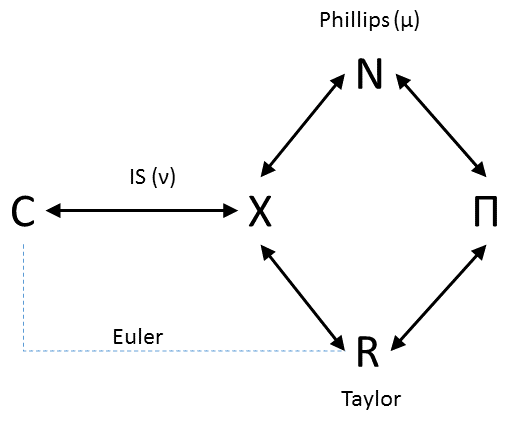
First off, you can always insert money into any information equilibrium relationship so that A ⇄ B becomes A ⇄ M ⇄ B. In a sense, adding money is generally trivial (it's a consequence of the chain rule and M/M = 1, and more generally, the consequence of scale invariance). And in the case of the IE NK model, it doesn't add any additional explanatory power. So here is the original network diagram of IE relationships in the IE NK model side by side with Nick Rowe's addition of money M between the relationships with the output gap X:


Let me define some of the other symbols here: N is nominal output, R is the nominal interest rate, Π is the price level, and C is consumption. The upper half of the loop is "the Phillips curve", the lower half is "the Taylor rule". The bit out the the side is "the IS curve", and finally there is an "Euler equation" (maximum entropy condition) relating consumption and the interest rate (blue dashed). The terms μ and ν are the stochastic innovation terms. I only point these out because μ is special, as I discuss below.

After first inserting the money demand piece (i.e. X ⇄ M), Nick points out an issue he has with the NK model centering around the Euler equation:
There is a continuum of equilibria, with anything from 0% to 100% unemployment being an equilibrium ... This result follows immediately from the Consumption-Euler equation. ... The real interest rate only pins down the expected growth rate of consumption, not the level of consumption.
... 
[NK] simply assumes, with zero justification for this additional (hidden) assumption, that agents in the model expect an automatic tendency towards full employment.
Nick says that the NK model places the return to equilibrium in the consumption side by assuming the system goes to zero output gap X(t) for long times r t >> 1. In his monetary version, he inserts money into the relationships and resorts to the "hot potato effect" to essentially say the output gap closes as extra money becomes uniformly distributed among agents. This effect is an entropic force in IE models. However, to me this just seems to be replacing one model assumption -- X(t) ~ 0 for r t >> 1 -- with another -- the hot potato effect.

The fact that the Euler equation doesn't set the level is true in the IE NK model because it is a relationship between consumption in two periods, and therefore has a scale invariance (see here for the equation). However, the tendency to close the output gap is actually derived from information equilibrium (one of the stochastic innovation terms μ is biased towards closing the output gap). It's still an entropic force (all IE relationships are sources of entropic forces), but it appears in the Phillips curve segment because of the relationship between nominal output and the output gap. The overall content is not very different from the original NK model. There, the output gap closes by assumption (e.g. expected to close). In the IE NK model, the output gap closes because of the tendency to restore information equilibrium (expected information equilibrium).

It might just be bias, but think the IE approach helps clarify what is happening in models and the discussion of them. Maybe that's just because I like pictures more than equations. In any case, the general idea behind Nick's post is captured in the diagram above along with moving the biased stochastic innovation term (biased towards output being equal to information equilibrium output) from the output gap into one of the money relationships.

It's more a re-organization and re-labeling than changing the model. Maybe that makes some people feel better. However and series of relationships A ⇄ M ⇄ B can be re-written in terms of A ⇄ B, A ⇄ M, or M ⇄ B because if the former is true, then the latter three are all true. In a sense, this allows you to trim any information equilibrium network diagram by removing unnecessary intermediaries. This is why I originally wrote the diagram like this:


The N appears in one of those redundant relationships and we can really just think of the output gap in terms of information flowing in the model. I kept the label simply because the N is required for the definition n = y + π.

Sunday, November 6, 2016

Defining bubbles in the information transfer framework

Yesterday I watched the NOVA episode Mind Over Money because that is the kind of thing that I do on the weekend (at least when my wife is off with her friends). It's sort of presented as a back and forth between the Fama camp and the Shiller camp and is generally entertaining (or might make you shout at the screen). I had actually seen it before (when it originally aired in 2010), but the appearances by John Cochrane and Gary Becker had new meanings for me (per here and here).

Anyway, bubbles are mentioned, and I was wondering how they might be understood in terms of the information transfer framework. I really do think that e.g. Scott Sumner or Eugene Fama have a point when they say the idea of a bubble is hard to define. Some assets go up fast and stay up. Others go up, and then collapse. Given what we colloquially think of as a bubble, you can never really identify it unambiguously until it has "popped". Housing in Arizona and Florida were bubbles; housing in San Francisco wasn't -- or at least might not be because it could still "pop", but that's the point. We don't know in real time. A lot of bubble detecting is done with 20/20 hindsight, which may be good history but is bad science.

With that as a prologue, I think I have a good definition of an asset price bubble in the information transfer framework: a surge in demand that outpaces supply followed by non-ideal information transfer. I did some simulations (following here) and here is the effect of an increase of demand that is faster than the growth of supply in a system with IT index k = 1.3


You can see the price launch up until the growth in demand stops outpacing the growth in supply. It then falls slowly afterwards until it eventually rejoins the original path. That's the idea price p*, however. One could easily imagine that as soon as the price reaches its zenith, there'd be a panic, correlation among asset sellers, and non-ideal information transfer. We'd have I(D) > I(S) and p < p*. Therefore the path would look more like the gray path rather than the dashed black path:


The precipitous fall in price after a bubble defined this way "pops" is due to panic and not fundamentals.

...

Update

Here is the 1987 crash:


...

Update 29 November 2016

Noah Smith on bubbles.

...

Update 17 February 2017

And here's an example of a non-bubble (surge in demand outstripping supply that isn't followed by serious non-ideal information transfer, but rather a slow decline back to "equilibrium"):


Saturday, November 5, 2016

A list of unsupported narratives in macroeconomics

I was watching Money for Nothing last night (exciting Friday night, I know) and since I had just compiled a list of valid and not so valid arguments against economics I thought of adding a valid one about creating false narratives that will link to this post. Humans love to create narratives; it's one of our skills. Macroeconomics loves a good story, and Money for Nothing is a good example (most of the narratives below appear in it). 

The (potentially growing) list below will consist of a set of narratives that are not conclusively supported by data. The general takeaway is that macroeconomic theory is not yet good enough empirically to support any particular story.

"Stagflation proved Keynesian economics was wrong"
The story goes that inflation and high unemployment (H/T John) in the 1970s was not supposed to happen in Keynesian economics, and therefore it was abandoned for some other theory (monetarist, natural rate, microfounded) that gets it right.

This is one of those cases where the victors seemed to re-write the history. There was apparently no reason "stagflation" couldn't happen -- in technical terms  that the Phillips curve was structural in Keynesian economics -- as discussed here and here (and scholarship by James Forder at the links).

"The Great Inflation and the Volcker Disinflation"
The stagflation story is part of this story. Basically, Lyndon Johnson's Great Society and the Vietnam War lead to too much government spending/aggregate demand. Coupled with Johnson bullying of Fed chair Martin to keep interest rates low, the country ended up with inflation. Carter's nomination of Volcker to the Fed, and the subsequent rise in interest rates put an end to high inflation.

However, the Martin story doesn't really make sense given the data. There were two major real shocks that plausibly contributed to inflation (the oil crises of 1973 and 1979). And we can't rule out that the inflation of the 60s and 70s wasn't actually demographic (see Steve Randy Waldman).

I've written more about this here (contra Paul Romer) and here (contra Matthew Yglesias).

"The Fed caused the Great Depression/Great Recession with monetary policy"
It's not so much of saying this story is wrong as saying it's not clear how the Fed did this. There are many stories involving monetary policy in different ways. Rising interest rates do appear to precede recessions, but generally the stories behind monetary policy involve you to believe in the detailed operation of theories where there isn't much evidence of them working for normal forecasting (because not much does) or on other data besides the Great Depression/Recession.  Another way to put this is that these theories tend to be "just so" stories.

"The Fed saved us from recessions with monetary policy"
This is usually in reference to the market crashes of 1987 (which resulted in no recession) and the early 2000s (which resulted in a mild one). Again, like the causes of Great Depression, these stories require you to believe the detailed operation of theories that don't match empirical data well (because few macro theories do).


Friday, November 4, 2016

Translating among the econ

I mentioned it on my blog the other day as well as here, but I thought I'd translate the snippet Duncan Black flagged as being an example of overly mathematical economics into a more readable form. I'll even emphasize the point by not using LaTeX.


Here's my translation of the mathematical symbols ...
     We assume that there are a finite number of commodities ℓ. The consumption of agent i is defined by the set of ℓ positive numbers labeled xᵢ. Agent i's utility function in state tᶰ is uᵢ(xᵢ,  tᶰ). We sometimes assume a quasi-linear economy: the ℓth quantity is a numeraire and the consumption of agent i is defined by ℓ-1 positive numbers and one positive or negative number xᵢ. The utility function uᵢ becomes uᵢ = vᵢ(xᵢ-ℓ, tᶰ) + xᵢℓ. The endowment of agent i of type ti is set of ℓ numbers labeled ωᵢ consistent with the definition of xᵢ (assumed to be independent of the state -- with this assumption, all private information concerns agents' preferences and beliefs.)
     These quantities now define an admissible exchange economy E. 

Or maybe we can go simpler ...
There is stuff. Each person has certain amounts of stuff and they like it to varying degrees. Sometimes one type of stuff is money and they like that differently. Everyone starts with some stuff. This defines an economy. 

Wednesday, November 2, 2016

A list of valid and not so valid complaints about economics

There was a paper from NBER that Noah Smith tweeted last night that showed that log-linearization wasn't really a big deal in a nonlinear New Keynesian DSGE model. Since this was essentially an explicit example of where a common complaint about economics and Taylor series approximations wasn't really valid, I was inspired to construct a (potentially growing) list of complaints about economics when it comes to science and mathematics based on my many posts on the subject.

In constructing this list, I found that several of these posts are in the top 5 most viewed posts (namely, #1, #3, and #5) making me realize that I am probably mostly seen out in the econoblogosphere as a physicist critiquing various approaches to economics rather than as the crackpot developer of the information transfer framework. This may bode well for my forthcoming book which is more critique than information theory. 

Update 4 November 2016: I want to emphasize that this is a list of complaints about economic methodology with emphasis on scientific method and mathematics. It is not supposed to be a list of effects economics includes/excludes or complaints about specific models. They might appear as examples (e.g. I mention DSGE below), but are not the primary complaint. It is primarily intended as a corrective to many complaints in the econoblogosphere that "economics is unscientific because of X" written by a scientist, where the X's are the top line complaints below.

Update 13 March 2017: I am adding some popular books critiquing economics where they might fall with the complaints below.

We'll start with the invalid complaints ...

* * *

Not so valid complaints about economics

"Economics keeps only the linear terms of Taylor approximations"
As mentioned above, I wrote an entire post on this. Keeping linear terms in Taylor series is usually fine, so this doesn't work as a general criticism. It could potentially work against a specific model.

"Economics ignores nonlinear models"
Part of this is captured in the post on Taylor approximations and the new NBER article. However, I also wrote a post (that is now the 5th most viewed post on my blog, with follow-up) addressing one of the better empirical arguments against using nonlinear models. As Roger Farmer's beautifully concise post puts it, without hundreds of years of data we can't meaningfully tell the difference between a nonlinear model and a linear model with stochastic shocks.

"Economics makes unrealistic assumptions"
In science, unrealistic assumptions are made all the time. What matters is the end result of those assumptions. This is how physics operates all the time and it is called "effective theory", and "effective field theory" (what Weinberg called phenomenological Lagrangians) is a formalization of the idea for advanced theoretical physics.

I wrote two posts (here, here) about this subject in response to someone making this claim.

"Economics has too much math"
My background is in physics, but I've been studying economics and finance for over 10 years. My experience is that the level of math being applied is generally appropriate to the problem at hand. Some aspects of economics appropriately aren't very mathematical. Development economics comes to mind.

However, this complaint tends to be made about macroeconomics and the study of the business cycle. These are two things that we would not even know exist without mathematics. For example, no single person can see all the output or all the employed and unemployed people at once. This data must be compiled, which generates numerical quantities. Additionally, prices are numerical. How does one deal with the rise and fall of interest rates without mathematics?

I've written three posts (here, here, and here) on this in which I've tried to understand this charge -- what is it really trying to say? There seem to be many different reasons that range from genuinely feeling left out of a field that has an important effect on people's lives to avoiding testing one's theory against empirical data.

Added 5pm PT. There is a possibly valid version of this in that a lot of economics is written too mathematically; I address this below.

Mathiness
Paul Romer made his big debut in the econoblogosphere with a paper on what he called "mathiness": the lack of technical rigor (Romer used the words 'tight links') in mathematical arguments in economics.

I read through his paper and his specific claims make no economic sense from the standpoint of dealing with the reality of economic systems. It's now my 3rd most-viewed post. I think Romer has touched on something, however, and the issue is really about domains of validity (scope), scales, and limits (see below).

Added 5pm PT. Some people have different interpretations of what "mathiness" is (Romer himself felt misunderstood on this subject [also, Romer's response to my post]). Some people consider "mathiness" to be writing economics with overly formal mathematical symbols, which I address below.

"Macro is like string theory (in a bad way)"
Paul Romer's second big splash was with a devastating critique of macroeconomics. Many of the critiques are valid. However, he uses an analogy with string theory to say macro is unscientific that really misunderstands string theory.

* * *

Complaints that depend on framing

"Economics is bad at forecasting"
This really depends on a lot of factors. Long run or short run? Does the theory actually say the result is forecastable?

DSGE models are designed to forecast over the short run, but appear to be unable to do so -- or do so worse than simple stochastic models. That's a valid complaint!

"Economics can't predict recessions"
Following the complaint about forecasting, we look specifically at recessions. Are recessions random, or are they predictable?

Science can't predict earthquakes, but can predict where earthquakes might occur and levels of strain building up in faults.

Some economic theories predict recessions to be quasi-periodic. But much like the problem with validating the forecasting abilities of presidential election models, we don't have a lot of recessions to work with in the time series. Even a model that predicted the past 3 or 4 recessions (meaning it would have had to have been built in the 80s) could have done so out of luck (although if it matched the severity and duration of those 4 recessions, that might be a real thing).

One should probably hold judgement until we have some evidence that recessions are predictable.

"Economics is unscientific"
Which aspect?

This is not a binary condition, but rather a continuum. String theory in physics could be considered unscientific in the sense that it has little connection to data. However, it's a very scientific extension of standard quantum field theory (you could call it the quantum field theory of strings instead of string theory, and in fact that is the title of a string theory book). So something can really be unscientific in one way, but scientific in another.

As I wrote about here, some aspects of economics appear unscientific (to me) while other aspects don't.

"Economics is not empirical"
Again, this depends on what you are talking about. VAR models are entirely based on empirical data. Sometimes DSGE models aren't compared to data. Sometimes they are.

"Economic quantities are phlogiston"
Added 4 Nov 2016. I remembered this one from Paul Romer's paper, but I think Matthew Yglesias was the source of my own usage with regard to total factor productivity. Phlogiston was originally thought to be the substance contained by combustible materials that made them burn. You can see the obvious circularity in the definition.

Economics introduces many different quantities when describing economic data. Utility, total factor productivity, technology shocks. Some are unmeasurable (utility). Some of these are dangerously close to phlogiston (TFP).

However, introducing new and possibly unmeasurable quantities has long been a part of science. Sometimes they end up being phlogiston. Sometimes they end up being momentum ("quantity of motion" per Newton). It may be true that utility is unobservable. However the quantum wave function is also unobservable.

Therefore, this should be considered on a case by case basis. It is hard to say whether TFP or utility will end up being useful quantities. I personally don't think so, but I also can't rule it out.

* * *

Valid complaints

The identification problem
I think Paul Romer did a delightful job explaining the identification problem. Basically the idea is that any system with m equations in m unknowns will have way too many parameters. Expectations and nonlinear models make this worse.

"Economics does not appear to treat limits properly"
In looking at Romer's mathiness complaint (above), I realized that the way that economists treat limits (taking variables to zero or infinity) is, in a word, sloppy. This can lead to some serious problems such as producing contradictory results or nonsense. The issue can be related to dimensional analysis and understanding the scales of the theory (Romer cedes that he -- and therefore likely other economists -- ignore scaling).

The basic idea is that 1) 0 and infinity are effectively related by 1/∞ ~ 0, and 2) both zero and infinity are dimensionless (have no units). This means you can never take the limit as time t goes to infinity t → ∞ because one has units (time has units of seconds, quarters, or generic time periods). The same goes for t → 0.

Therefore, if you ever want to take limits, you need to understand what your fundamental time scale t₀ (with units of seconds, etc) is so that you can take the limit t/t₀ → ∞. In physics, we tend to write this as t/t₀ >> 1 (the double greater than signs read as "much greater").

The practical result of this is that there are a ridiculous number of undefined (or implicitly defined) time scales like t₀ hiding in economic theory.

Romer's mathiness complaint ends up being wrong because he didn't realize that his double limit makes zero sense because he effectively takes both t → ∞ and t₀ → ∞ in different orders and (as would be expected) ends up with nonsense.

Now you don't have to actually take the limits in order to have these implicit scales in your model. To my chagrin, I pointed this out about stock-flow consistent models (what is by far my #1 most-viewed post), and received a barrage of comments saying that I didn't understand what I was talking about from people suffering from the Dunning-Kruger effect.

"Economics does not deal with domains of validity (scope)"
Every theory, every model, has a range of inputs over which it is valid. In physics, we call it domain of validity (e.g. Sean Carroll uses the term here and here), but Noah Smith appears to think we call it scope conditions (which I think is actually a sociology term). Regardless of what you call it, economics doesn't address it much. Noah says: "I have not seen economists spend much time thinking about domains of applicability (what physicists usually call 'scope conditions'). But it's an important topic to think about."

It is. It is very important. It is closely linked to the scales and limits mentioned above.

Newtonian physics for example is valid for speeds v where v/c << 1 (the scope) where c is the speed of light (the scale [1]). When v ~ c, then Einstein's theory of relativity becomes important.

Because economic theories have implicit scales floating around, and does't take limits properly, one ends up with a confused mess when one tries to understand the scope of any particular model or formula. For example, I looked at the present value formula (more accounting than economics) in this light.

In a more interesting example, utility maximizing rational agents clearly fail when you have N = 1 agent as shown by many experiments. However, they appear to be a decent approximation when N ~ 20 agents in at least one experiment. As Gary Becker showed, you get the same results from an ensemble of irrational agents as you do from a single rational agent. I made the case that rational agents with many of the properties economists assume (but do not appear to be true of individual agents) could emerge in systems with a large number of agents.

What if there was a group scale of N₀ people (say, 100) [2] which told us that when N/N₀ >> 1 we can assume rational utility maximizing agents? This would make sense of the failure of individual (N = 1) human behavior to appear rational. The rational agent model is out of scope for individual humans.

I am not saying that is definitely true; it is just a possible resolution. It's also a possible resolution that would be clearer to understand if economics treated scopes and scales more rigorously.

Books:

Dani Rodrik's Economics Rules (although I don't necessarily agree with the solution)


"Economics is written too mathematically"
Added 5pm PT. I think some people see this as "mathiness" or "physics envy", but the following snippet (flagged by Duncan Black, himself an economist) is a not-uncommon paragraph from an academic economics paper:


I wrote about this here. I think writing papers in this style obscures more than it illuminates. As I wrote at the link: "There is quite literally no reason for an economist to refer to the real numbers as ℝ or even refer to real numbers at all. To say x ϵ ℝ+ is pretentiousness compared to x > 0." Overall, this is a superficial complaint; the mathematics underlying the terse symbols is usually relevant. It could just be written in simpler, less symbolic language. It really is just an academic culture of writing papers like this (something that "looks like an economics paper").

"Economics accepts stories too easily"
Added 5 Nov 2016. This is probably more a human failing than one specific to economics, but macroeconomic theories are used to produce narratives that are proffered with a certainty that far exceeds their empirical success at describing macroeconomies. I've compiled a list here.

I'm not endorsing the rest of his book or ideas, but Nassim Nicholas Taleb writes about this calling it the narrative fallacy.

Science is primarily as a defense against fooling yourself (Feynman), and narratives constructed by your left brain interpreter are a very seductive way to fail. Data first, story later.

Books:

James Kwak's Economism (although he makes the distinction that what he calls "economism" isn't really economics)


...

Footnotes:

[1] For those interested, c comes from the Latin for "quickness": celeritas

[2] For example in physics, when the number of "agents" (atoms) N >> Nₐ (Avogadro's number ~ 10²³), chemistry and thermodynamics are the valid effective theories of Newtonian and quantum mechanics -- that differ from them quite extensively. Maybe something like this happens in macroeconomics?

Tuesday, November 1, 2016

Economics, physics, and data: a response to Blackford

The economist George H. Blackford responded to my snark-laden criticism of his article in Evonomics. In part, he accused me of not reading his work and links carefully or completely so I have been taking my time with my response. The format below includes quotes that I am responding to the substance of, or that represent markers for a few paragraphs that I am responding to. Just below the quotes, I give the TL;DR summary of my response ("too long; didn't read").

First, let me give the overall TL;DR it's own TL;DR: Pick another target to criticize in economics. Don't make analogies with physics. Friedman's "as if" methodology is not the issue here, Dude.

Here's the overall summary ...

TL;DR

Blackford makes a case that Friedman's "as if" methodology is the source of the "bad science" in economics, and I guess via the "bad begets bad" heuristic, much of the bad policy as well as the bad aspects of the economy. However Friednman's methodology isn't the only reason economists use rational agents, there are other potential sources of bad policy that aren't derived from the "as if" methodology (e.g. the EMH, the "Laffer curve"), and there exist rational agent theoretical explanations of stagnation and the financial crisis consistent with Friedman's "as if" methodology.

Macroeconomic data is so uninformative that despite not being a great description of the empirical data, mainstream macroeconomics (mostly New Keynesian DSGE models) hasn't actually been rejected by the data. Mainstream economics is "unscientific" (in my opinion) by being too complex (e.g. too many parameters) for the available data. However none of this has anything to do with Friedman's "as if" methodology.

Friedman's description of e.g. Galileo's law of falling bodies is actually quite excellent from this physicist's perspective for being written in 1953. His "as if" methodology is essentially an argument for effective theory that physicists wouldn't get to until the 1970s and 80s. While Friedman makes a few errors in his descriptions of physics in his analogies, there is nothing in physics that would discredit this general approach. Therefore any counter argument invoking Newton, Einstein, or science in general misunderstands or misrepresents them. The arguments against Friedman (which definitely exist!) should be confined to economics and economic data.

I am not defending conservative politics. I think this quote from Paul Krugman probably characterizes my view here:
I’m on record declaring Friedman a “great economists’ economist”. His work aimed primarily at a professional audience — the permanent income theory of consumption, the case for flexible exchange rates, the natural rate (even if it does break down at low inflation), the optimum quantity of money — was often, maybe even usually, brilliant, and will live on. 
What isn’t living on, however, is Friedman’s role as a guiding light for conservative economic policy.
/TL;DR


* * *
"Which side of this argument [about how scientific economics is] are you on?"
TL;DR "As if" = scientific, not comparing to data = unscientific, too complex = unscientific, adding things to theory despite not improving understanding of data = unscientific

I'm not really sure there is a dichotomy of "sides" here. There are a lot of attacks on economics that say it is unscientific, and there are defenses. There are attacks on string theory as unscientific, even by physicists like Lee Smolin. At the edges of understanding -- beyond wikipedia science (where everything has already been figured out) -- any field will have trouble meeting every expectation of being scientific.

In some ways, string theory isn't "scientific". There aren't very many experiments that test it (though there are some that test aspects of it), so it's not grounded empirically. In my post on this question (as an analogy with economics), I show that string theory is a natural extension of very successful theoretical frameworks (and contains them), so it's scientific.

Macroeconomics does not have any successful theoretical frameworks, so the "string theory defense" I make in my post doesn't apply to e.g. DSGE models. In fact, in comparison to string theory, macroeconomics has tons of data that it should be explaining. And that is where the failure to be scientific is. Macroeconomic time series only has a few thousand data points, though, so macroeconomic models need to be simple (have few parameters) [or come from microfoundations, with micro theory parameters fit to data].

In the end, it's particular aspects of theoretical and empirical approaches that are scientific or unscientific. And my defense of Friedman against Blackford's argument was restricted to Friedman's "as if" methodology, which is identical to effective theory as practiced by physicists and so is pretty scientific.

However the lack of comparison of (mostly macro-) economic theory with data -- data that exists -- is unscientific. So are the models that are too complex to be supported by the limited available data. In his Evonomics article, says that several things should be included (for example: inequality, debt accumulation) without any indication that they improve the theoretical description of the empirical data. I said this was like adding aether to physics. At the time, physicists felt in their bones light waves had to propagate in some medium. Not only was there no empirical evidence for this, but it actually led down the wrong path.

* * *
"My paper is about how Friedman’s as if methodology is used in economics."
TL;DR Not all uses of rational agents are a result of Friedman's "as if" methodology

The purpose of Friedman's paper was definitely to defend the "rational agent" and "Chicago school" view of economics. And I agree that the modern perception in economics of Friedman's paper differs from how a physicist would look at it. For example, Noah Smith perceives the billiard player analogy as something very different from how I look at it.

In reading Friedman's paper, he seems to be saying, with regard to assumptions that:

  1. Unrealistic assumptions are not a problem if predictions are good
  2. Predictions are more important than realistic assumptions
  3. More significant theories will have less realistic assumptions
  4. Judge assumptions by whether the are good approximations and lead to predictions

With the exception of #3, this is basically effective theory. And my defense of Friedman is restricted to this aspect.

Friedman does use his "as if" methodology to support his free market view of the world and rational agents, and part of that is in #3 -- something that is purely a matter of opinion. I'd say that if very unrealistic assumptions led to accurate predictions, then you probably have stumbled on a deep or emergent result that doesn't have much to do with the assumptions (Friedman appears aware of this possibility when he says "For all I know there may be other sets of assumptions that would yield the same formula." with regard to falling bodies in physics [and there is! q.v. Section III.B.]).

From my experience, modern economists interpret Friedman's "as if" approach to unrealistic assumptions as a defense of the use of rational agents. However not all uses of rational agents in economics follow from modern economists using the "as if" methodology.

For example, here is David Andolfatto saying that rational agents (underlying DSGE models) are just a starting point
"We are all scientists trying to understand the world around us. We use our eyes, ears and other senses to collect data, both qualitative and quantitative. We need some way to interpret/explain this data and, for this purpose, we construct theories (or hypotheses, or models, or whatever term you prefer). Mostly, these theories exist in our brains as informal "half-baked" constructs. This is not meant to be a criticism (as long as we recognize the half-baked nature of our ideas and why some humility is always in order). Often it seems we are not even aware of the implicit assumptions that are necessary to render our views valid. Ideally, we may possess a degree of higher-order awareness--e.g., as when we're aware that we may not be aware of all the assumptions we are making. It's a tricky business. Things are not always a simple as they seem. And to help organize our thinking, it is often useful to construct mathematical representations of our theories--not as a substitute, but as a complement to the other tools in our tool kit (like basic intuition). This is a useful exercise if for no other reason than it forces us to make our assumptions explicit, at least, for a particular thought experiment. We want to make the theory transparent (at least, for those who speak the trade language) and therefore easy to criticize. Constructive criticism is the fuel that fires the furnace of new ideas in academia."
Roger Farmer argues that we need DSGE (and therefore the rational agents underlying it) to understand general equilibrium. Simon Wren-Lewis simply says the rational agent DSGE models were an improvement over what had come before. DSGE models represent the current "mainstream" approach to macroeconomics, and are the modern incarnation of the rational agent approach. They do not result from Friedman's "as if" methodology.

* * *
"As far as I can tell, the basic paradigms of physics are not, for the most part at least, based on demonstrably false assumptions"
TL;DR They are, and the way that is understood is exactly Friedman's "as if" methodology.

General relativity is incompatible with quantum mechanics. Therefore one theory's assumptions are demonstrably "false" (we don't know which one yet, we think GR). The Standard Model does not have neutrino masses/neutrino oscillations, and is therefore demonstrably "false". Calculating the vacuum energy of empty space gives an answer that is off by 120 orders of magnitude, and therefore the assumptions of quantum field theory are demonstrably "false".

However no physicist really thinks of these in terms of true/false, but rather in terms of scope and scale. General relativity and quantum mechanics have different scope that only overlaps at energies higher than we can reach with experiments or near black holes. Neutrino masses are a very small correction to the Standard Model. Quantum field theory is limited to energies well below the Planck scale.

That is to say physicists deal with demonstrably false things by assuming any theory is an effective theory with limited scope. And effective theory is exactly Friedman's "as if" methodology.

* * *
RE: The discussion of Newton's laws
TL;DR At the time, the assumptions involved in Newton's laws had no independent truth value besides the retro- and pre-dictions of Newton's theory.

Yes, Newton's version is hard to parse, especially using F = m a as a frame (which is not generally true, even ignoring relativistic and quantum effects). The Latin is:
Lex II: Mutationem motus proportionalem esse vi motrici impressae, et fieri secundum lineam rectam qua vis illa imprimitur.
Blackford quotes one interpretation:
The alteration of motion is ever proportional to the motive force impressed; and is made in the direction of the right line in which that force is impressed.
The modern understanding is:
The change of momentum of a body is proportional to the impulse impressed on the body, and happens along the straight line on which that impulse is impressed.
This is best interpreted mathematically as

I ≡ Δp

where I is impulse and p is the momentum vector. The instantaneous force is (by the fundamental theorem of calculus, therefore no assumptions of relationships in the world)

I = ∫ dt F

F ≡ dp/dt

where p is the momentum vector. The alteration of "motion" (i.e. momentum) is Δp (or infinitesimal dp), and the rest of the definition says that the F vector (and impulse vector I) is parallel to the p vector. Newton would have writen in his own notes something like f = ẋ using his fluxions (i.e. f = dx/dt).

As you could just work in terms of momentum p (which is conserved via Newton's 3rd law, although the conservation is actually considered more fundamentally a consequence of the universe having approximate Galilean invariance -- SO(3) spatial symmetry plus velocity shear transformations) and its derivatives, defining force is unnecessary and mostly a notational convenience that helps with calculations.

However, what Newton "really meant" is still debated. And yes this is mostly semantics, but it is relevant background.

Blackford continues:
"... if the assumptions underlying Newton’s law had been demonstrably false his law would not have been accepted by physicists in the way in which economists are willing to accept false assumptions in economics."
This misunderstands the scientific method at work here. Newton's laws were accepted because they organized previous work by Galileo, Kepler, and others into a simpler framework. Newton explains tides, orbits, the Earth's oblateness, and Kepler's laws using his three laws plus his gravitational law. It's the results of the assumptions, not the assumptions themselves, that are compared to the empirical data.

At the time, the criticisms of Newton were mostly philosophical -- and included rejection of Newton's use of Galileo's empirical approach that we now call science. We can't really know what would have happened if any of Newton's laws were "false". They mostly aren't except for quantum and relativistic effects, and at the time they were pretty much untestable themselves because they require doing experiments in a vacuum, and no one could test F = m a by applying a force to the Moon.

Basically, in the 1600s and 1700s the assumptions involved in Newton's laws had no independent truth value apart from their results. They were accepted because they explained a lot of things with very little -- which is exactly what Friedman says:
"A hypothesis is important if it 'explains' much by little, that is, if it abstracts the common and crucial elements from the mass of complex and detailed circumstances surrounding the phenomena to be explained and permits valid predictions on the basis of them alone."

* * *
"It seems quite clear to me, even if it is not clear to you, that 'unrealistic' is nothing more than a euphemism for terms such as ‘wrong’ or ‘false’ or the expression ‘contradicted by empirical evidence’ in Friedman’s arguments and as used by other economists as well.  It's the term economists use when they don't wish to use the more explicit term or expression."
TL;DR If these terms are synonyms, then this leaves no room for approximations or analogies with physics. Additionally, if one understands these terms synonyms, then one will misunderstand Friedman's paper.

I can surely believe this is how some economists and other people use these words (from my own experience), but if these words are all synonyms then any analogy with physics using them will not make any sense. Sorry, but I have to be a bit pedantic here.

"False" is either half of the Boolean or logical binary or as an adjective where one could use the pseudo- prefix. I am not sure "false" is ever really used in physics except in a generic narrative or as an adjective like "false vacuum". Happy to be contradicted. But physicists would never say Galileo's law or Newton's laws (assumptions) are "false" when they mean that Einstein's theories are better approximations when v ~ c. Newtonian physics and Galilean invariance are valid approximations under certain conditions.

"Wrong" could be a method that fails. For example, there are wrong arguments that lead to correct results (old quantum theory leading to the Bohr energy level formula, or this argument about spin-statistics). Or it could be that X is wrong because the answer is A and X - A ≠ 0. This does not say anything about the magnitude of the error. Wrong can mean "way off" or "approximately right". Again, Friedman makes exactly this point.

"Unrealisitc" is a relative term. But the unrealistic Einstein solid gives a comparable explanation to more realistic Debye model. Is it unrealistic to assume a surface is frictionless? That depends on how big a role friction plays. Basically, something can be unrealistic and approximately right. And again, Friedman makes exactly this point.

"Contradicted by empirical evidence" is, as the phrase implies, an empirical claim. In physics, this would have some scope attached. Using Newton's laws to calculate something involves assumptions contradicted by all the empirical evidence behind relativity and quantum mechanics (say, the survival of muons at the surface of the Earth produced cosmic rays). But physicists assume e.g. the speed of light is infinity as an approximation all the time.

To bring this back to economics, rational agents are both contradicted by empirical evidence (people fail to optimize the public goods game) and not contradicted by empirical evidence in (the field experiments of List 2004).

Does this mean the rational agent assumption is both right and wrong? Realistic and unrealistic? True and false? In physics, we'd say it is an approximation that works in some cases, but not others. Again, Friedman makes exactly this point.

If you take these terms as synonyms, then it would not only be impossible to understand physics, but additionally impossible to understand Friedman's paper. Friedman is obviously not using these terms as synonyms because he makes direct statements about the degree of error and how close a prediction is to the empirical evidence.

* * *
"mainstream economists justified deregulating the financial system 'on the basis of an economic theory that assumes speculative bubbles cannot exist'"
TL;DR The EMH is the source of the push for deregulation, not "as if" methodology

I would be fine with this if you added "some" in front of the "mainstream economists". Some mainstream economists study speculative bubbles and financial crises (I offered Reinhart and Rogoff as an example).

However I don't think Friedman's "as if" methodology is the source of the push for deregulation, but rather the efficient markets hypothesis. The EMH is the reason people believed speculative bubbles can't exist (because the best available information is purportedly included in the price). And the EMH was directly based on empirical data (prices following random walks). However, the push for financial deregulation was all Fama and no Shiller -- Shiller's additional empirical studies noted deviations from the EMH.

Actually, it seems to be the failure of Friedman's "as if" methodology that lead to this interpretation of the EMH. Instead of saying markets behave "as if" information was included in asset prices even though it might not be, the deregulators treated the EMH as saying that information was definitely included in asset prices.

* * *
"gratuitous accusations and innuendo"
TL;DR These quotes are actually serious points, and Blackford avoids them by essentially calling them ad hominem attacks. A few are derived from a section I blocked off that was about heterodox economics in general, not Blackford specifically.

I stand by the statements I made the list of quotes Blackford cites. He points to the 2008 financial crisis as evidence of the failure of "mainstream economics". That literally is a single data point. Mainstream economists Reinhart and Rogoff studied hundreds of financial crises, and they come away with a far more nuanced conclusion that more financial regulation is required, not the complete failure of "mainstream economics" since Keynes. They also don't mention Friedman's "as if" methodology.

At this point I have no idea what Blackford means by "mainstream economics". It seems to more closely hew to so-called "freshwater economics", however the predominant consensus view in academic economic community is closer to "saltwater economics". In fact, if instead of "mainstream economics" he had said "economic theories supported by Republicans, libertarians, and conservatives", I might have had no problem with his article except for the bit about physics and effective theory. Milton Friedman is a definitely source of "Republican economics" (but not anymore), and many a conservative ideologue has been unscientific. This confusion is what I mean by the "neoclassical slant Blackford ... conflate[s] with mainstream economics".

But even if we restrict ourselves to "freshwater economics", there are explanations of e.g. stagnation or financial crises that appear consistent with the data to the level of Blackford's own narrative explanations of the data (more on this below). Specifically, since financial crises and recessions are unpredictable in versions of that view, the 2008 financial crisis is not evidence of its failure.

The remaining quotes Blackford cites are derived from a separate section (blocked of with asterisks) that is about alternative approaches to (i.e. heterodox) economics in general. Not everything applies to Blackford.

I used the word "positive" in the sense of "consisting in or characterized by the presence or possession of features or qualities rather than their absence". As in giving an example of a scientific approach, rather than presenting "negative examples" of things that aren't scientific approaches. It was an objective adjective, not a normative one.

I included the term "crackpot" in my description of Carroll's alternative science checklist. I actually refer to myself as a "crackpot" many times, and to Carroll's list as the "crackpot checklist" which I strive to follow (e.g. here from a few years ago). I think Blackfords interpretation of how science operates is incorrect, and not all uses of rational agents derive from Friedman's methodology. However I don't think Blackford or his economic ideas are "crackpot". I actually agree with most of the social and political implications, and the narrative he tells (in his links) is plausible given the data (more on this below). Again, this is in a separate section directed at heterodox economic in general.

* * *
"If you had bothered to look at these references ... it would have become apparent to you that I have spent an excruciating amount of time and effort in examining data and attempting to develop a theory that explains that data"
TL;DR I did read the references and there is no theory there that explains the data that is relevant to Friedman's "as if" methodology.

Ah, the classic "you didn't read my references". I actually did look at the references, but there appears to be no theoretical model of data at any of the links. There is a graph of some data in Ideology Verus Reality, as well in the links to chapters of his eBook in the Evonomics post, but that is not theory explaining data. Blackford seem to be telling a story that appears to be plausible and/or consistent with the data. However, what are the magnitudes of the effects of deregulation, inequality, and/or debt accumulation? Can I predict anything? We don't know because Blackford's theory is generally not a mathematical theory, and where it is (e.g. here), it is not compared to empirical data.

It is true that as a physicist, I am biased towards mathematical theory, where most others think of "theory" as representing non-mathematical ideas from "critical theory" to Darwin's theory of evolution (which despite the popular impression, does actually have many quantitative mathematical aspects e.g. here or here).

Regardless of one's opinion of mathematical theory in economics, Friedman's "as if" methodology was definitely talking about mathematical theory. He talks about formulae, predictive error, approximations, and comparing the results of formulae the data.

And that's a problem. Blackford is presenting a narrative (non-mathematical theory) as a counterpoint to the mathematical fruits (say, DSGE/RBC models) of Friedman's arguments about mathematical theory. It's a category error. One needs a mathematical theory that does better than the fruits of Friedman's arguments about mathematical theory in order to show the failure of those fruits. However, most mathematical theories seem to suck (ironically, the EMH based theory of a random AR process does best at forecasting).

But regardless of how much mathematical theories suck, they're still the only thing that can be quantitatively compared to numerical data in economics (interest rates, output and growth). Narrative explanations of economic history, from Keynes to Blackford, from Milton Friedman to Scott Sumner, are generally created by intelligent people and human brains are remarkably adept at creating narratives out of the noisiest data.

And it would be a mistake to assume other narrative theories don't have explanations following from excruciatingly examining the exact same data set one is using to construct one's own narrative theory. Part of the reason a lot of neoclassical or "freshwater" economics still exists is probably because the narrative versions are completely consistent with the data.

This is why I like meth. I mean math. Comparing theoretically calculated quantities to empirically measured ones is concrete in such a way that you can at least tell when something is wildly wrong or approximations fail. Physicists have been doing since Newton, but economists have generally only been doing this since Samuelson so it may take awhile to catch on. Additionally, math lets other people use your theory. I can't use Blackford's theory, but he could easily use mine.

Blackford also claims that his references support his claims about the financial crisis representing the failure of mainstream economics, however at the links there are simply more details about the claims, not supporting evidence. To his credit, Blackford does at least mention Reinhart and Rogoff:
"At the same time the most serious depressions involve financial crises that have at their root the inability to service debt. [Reinhart and Rogoff]"
However this statement of part of Reinhart and Rogoff's thesis is about sovereign debt crises (e.g. the European debt crisis, or the Asian debt crisis), and has nothing to do with the US financial crisis, Milton Friedman's "as if" methodology (he's not popular in Europe) , or "freshwater economics" (Blackford's "mainstream economics", which is not as prominent outside the US).

* * *
" ... you would not have so flippantly assumed that adding government expenditures to an economic model is all you have to do ..."
TL;DR Reading comprehension fail.

I explicitly did not assume that. After quoting Blackford:
"Is it any wonder that this [economic] paradigm ignores the relevance of the essential role of cooperative action through democratic government"
I said:
"I'm pretty sure that government spending is discussed as part of mainstream economics. ... Is this supposed to be some kind of other role?"
My point was not about government spending being sufficient; I ceded that government spending was one role of government that has been empirically validated. I was asking a question. What role of government besides government spending does Blackford want to add to economic models that isn't studied by mainstream economists, and what improvement does this make in those models' explanation of the empirical data?

Ther is no answer to this.

* * *
"... you seem to view the economic system as something comparable to a physical system that can be understood and explained by developing equilibrium models that accurately predict economic data. I see economics as much more than this."
TL;DR This is irrelevant to Friedman's "as if" methodology

Let me just rewrite this in a way that more accurately characterizes my view.

The economic system is at times comparable to a physical system that can be understood and explained by developing models that accurately predict economic data, but at other times this understanding just represents a bound where no rational answer exists. I've put this in the context of Keynes Book 1 versus Keynes Chapter 12 before.

However it makes no sense to talk about economic theories that aren't about accurate predictions when Friedman's "as if" methodology is entirely about ignoring the assumptions of economic theories when they make accurate predictions.

* * *

"I see economics as the study of a vital part of our social system ..."

I have no problems with anything said in the closing paragraphs. However it is critical to Blackford's view that one is correct about how social and economic systems operate. And in order to determine if a theory is correct, its claims about empirically measurable quantities have to be tested. Blackford's theories make claims about empirically measurable quantities (e.g. unemployment and interest rates).
Friedman's effective field theory

In preparing my response to George Blackford here, I have re-read Friedman's paper [pdf] once again, and I'm surprised by how good this is from a physicist's perspective. Is Friedman anticipating effective field theory (which doesn't happen until the late 70s and early 80s) in 1953? I only had to make one correction make these paragraphs presentable in a physics class:
We may start with a simple physical example, the law of falling bodies. It is an accepted hypothesis that the acceleration of a body dropped in a vacuum is a constant [near the surface of the Earth] - g, or approximately 32 feet per second per second on the earth - and is independent of the shape of the body, the manner of dropping it, etc. This implies that the distance traveled by a falling body in any specified time is given by the formula s = ½ gt² , where s is the distance traveled in feet and t is time in seconds. The application of this formula to a compact ball dropped from the roof of a building is equivalent to saying that a ball so dropped behaves as if it were falling in a vacuum. Testing this hypothesis by its assumptions presumably means measuring the actual air pressure and deciding whether it is close enough to zero. At sea level the air pressure is about 15 pounds per square inch. Is 15 sufficiently close to zero for the difference to be judged insignificant? Apparently it is, since the actual time taken by a compact ball to fall from the roof of a building to the ground is very close to the time given by the formula. Suppose, however, that a feather is dropped instead of a compact ball. The formula then gives wildly inaccurate results. Apparently, 15 pounds per square inch is significantly different from zero for a feather but not for a ball. Or, again, suppose the formula is applied to a ball dropped from an airplane at an altitude of 30,000 feet. The air pressure at this altitude is decidedly less than 15 pounds per square inch. Yet, the actual time of fall from 30,000 feet to 20,000 feet, at which point the air pressure is still much less than at sea level, will differ noticeably from the time predicted by the formula - much more noticeably than the time taken by a compact ball to fall from the roof of a building to the ground. According to the formula, the velocity of the ball should be gt and should therefore increase steadily. In fact, a ball dropped at 30,000 feet will reach its top velocity well before it hits the ground. And similarly with other implications of the formula. 
The initial question whether 15 is sufficiently close to zero for the difference to be judged insignificant is clearly a foolish question by itself. Fifteen pounds per square inch is 2,160 pounds per square foot, or 0.0075 ton per square inch. There is no possible basis for calling these numbers “small” or “large” without some external standard of comparison [n.b. scale of the theory]. And the only relevant standard of comparison is the air pressure for which the formula does or does not work under a given set of circumstances. But this raises the same problem at a second level. What is the meaning of “does or does not work”? Even if we could eliminate errors of measurement, the measured time of fall would seldom if ever be precisely equal to the computed time of fall. How large must the difference between the two be to justify saying that the theory “does not work”? Here there are two important external standards of comparison. One is the accuracy achievable by an alternative theory with which this theory is being compared and which is equally acceptable on all other grounds. The other arises when there exists a theory that is known to yield better predictions but only at a greater cost. The gains from greater accuracy, which depend on the purpose in mind, must then be balanced against the costs of achieving it. 
This would only get better if Friedman had said we should measure an effective value of g for each object or for different altitudes (or add in terms v0 t + s0).

I am not defending the implications Friedman makes from this analogy about economics -- although I will say that this would be an excellent argument for defending the use of rational agents if rational agents lead to empirically successful theories. The problem is that this analogy doesn't defend against theories that fail to match the data which is a more serious issues in economics than a particular mathematical approach.

Saturday, October 29, 2016

Q3 2016 US NGDP

The latest number came in with the highest growth rate in the past 2 years. Here it is from the perspective of the NGDP-M0 path -- where it looks like mean reversion:


3D visualizations of the interest rate model


The IT interest rate model results in the formula

log r = a log N – a log M – b

where N in nominal output (NGDP), M is the monetary base minus reserves, and a ~ 2.8 and b ~ 11.1 (pictured above). This formula represents a plane in {log N, log M, log r} space. If we wrote it in terms of {x, y, z}, we'd have

z = a x –  a y – b

And we can see that the data points fall on that plane if we plot it in 3D (z being log r, while x and y are log N and log M):


Update + 4 hours

I thought it might be interesting to "de-noise" the interest rate in a manner analogous to Takens' theorem (see my post here). The basic idea is that the plane above is the low-dimensional subspace to which the data should be constrained. This means that deviations normal to that plane can be subtracted as "noise":


The constrained data is blue, the actual data is green. This results in the time series (same color scheme):


The data is typically within 16 basis points (two standard deviations or 95%) of the de-noised data.