Tuesday, October 6, 2015

Neutrino oscillations


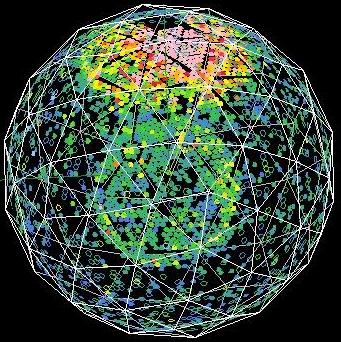
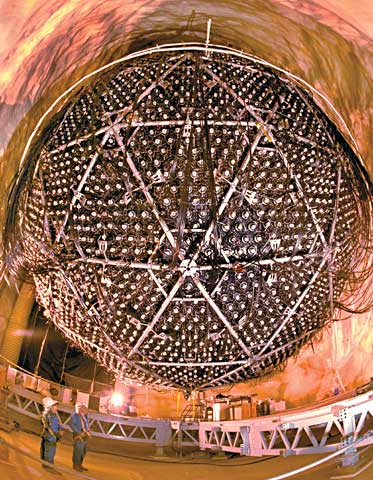
Congrats to the new Nobel prize winners in physics. I actually just mentioned neutrino oscillations the other day. The solar neutrino problem was a pretty big deal for awhile there. Some of my fellow grad students worked on SNO and we had a pretty neat live feed of SNO events (pictured above). I recall a controversy about whether to dump some salts into the thousands of gallons of heavy water borrowed from the Canadian government to deal with background noise.

Monday, October 5, 2015

Coins as a monetary aggregate

Scott Sumner muses that coins might be a good monetary aggregate to look at for what we call "money". We don't have FRED data for the US, but data for Japan is readily available here. Here is the [YoY] growth rate of the supply of coins (the vertical lines indicate recessions in Japan):


Multiply by 100 to get percent. Using coins gets the 1991-2, 1998 and 2008-9 recessions rights, but has a false positive for 1994 and 2005 and misses the 2001 recession.

It doesn't do very well in this model, either:


The better graph uses currency = notes + coins.


Sunday, October 4, 2015

Corporate prediction markets aggregate random behavior


Alex Tabarrok linked to a (gated) paper on how "corporate prediction markets work well" as Tabarrok puts it. Robin Hanson in comments says that it depends on what you mean by "worked" — the companies in question discontinued the prediction markets. Anyway, I found an ungated older version [pdf, broken, now here] (it actually points to Koch Industries as the anonymous Firm X in the final paper) and had a look.

Anyway, one thing it points to as evidence of functioning markets are a couple of figures where (scaled) price of the security is roughly equal to the (scaled) payoff:


Here's the accompanying text:
Figures [1 and 2] graph the future value of securities, conditional on current price for binary securities at Google [and] Koch ... respectively. The prices and future values of binary securities range from 0 to 1, and trades are divided into 20 bins (0-0.05, 0.05-0.1, etc.) based on their trade price.The average trade price and ultimate payoffs for each bin are graphed on the x and y-axes, respectively. A 95% confidence interval for the average payoff is also graphed, along with a 45-degree line for comparison. ... 
Google and Koch’s markets appear approximately well-calibrated. Both markets exhibit an apparent underpricing of securities with prices below 0.2, and an overpricing for securities above that price level, but this is slight, especially for Koch.
So following the $\hat{p}_{i} = \hat{p}_{j}$ with scaled $p_{i}$ (price in period $i$) indicated with a hat and scaled $p_{j}$ (payoff in period $j$) is some indication the market is forecasting well? That's odd because in the maximum entropy picture, that's exactly what you get with random market exchanges. If we go back to the maximum entropy asset pricing equation:

$$
\text{(5) }\; p_{i} = \frac{\alpha_{i}}{\alpha_{j}} \frac{\partial U/\partial c_{j}}{\partial U/\partial c_{i}} p_{j}
$$

Or more transparently for our purposes, equation (4) right before it

$$
\text{(4) }\; p_{i} = \frac{c_{i}}{c_{j}} p_{j}
$$

If we scale $p_{i}$ and $p_{j}$ we can remove the pricing kernel so that

$$
\hat{p}_{i} = \hat{p}_{j}
$$

The only assumption is that there are a lot of time periods between $i$ and $j$. In the Google example, there were 10 time periods (dimensions $d$), so we should expect deviation from the previous formula that is on the order of

$$
\varepsilon \sim 1 - \frac{d}{d + 1} \approx 9 \%
$$

which is about what we see. The Koch Industries markets had 58 periods which means about 2% error, but that market only had 57 participants as opposed to Google's 1,465 which would add roughly errors of 13% and 3%, respectively (using the $1/\sqrt{N}$ heuristic). Adding these in quadrature, we get 13% for Koch and 9% for Google for a back-of-the-envelope error calculation. Since these data are scaled, that means about 0.1 for both markets (after rounding). I added the error bars in orange to the data:


Works pretty well for back of the envelope! Systematic low prices are indicative of non-ideal information transfer.

Saturday, October 3, 2015

So many monetary policy shocks!

Scott Sumner shows the fall in the Euro (vs the Dollar, I believe) after Draghi's announcement to do whatever it takes at the beginning of September from 1.12 to 1.11. Here's a broader view from Bloomberg (September 3rd is marked):

This graph covers the region from about 1.25 to 1.05 -- about 20 times the range of the graph in Scott's post. By the standard of that graph, there appears to be several monetary policy events of equal size each month over the past year.

Another interpretation is that there are people in forex markets who trade on random dupes that try to trade on that "new" information. It doesn't sound like a good basis for a macroeconomic theory. The fall from the Draghi announcement vanishes into the noise in a few days, therefore it probably didn't matter that much.

In general, it appears that markets make "mistakes" -- going in some direction based on macro policy announcements regardless of whether that macro policy will have the outcome it purports to have. This seems particularly significant in forex markets.

Mistakes, random behavior or complex behavior?

Complex quasi-random and pseudo-random points in [0,1] x [0,1] ... or a lattice with random mistakes?


Mark Thoma points us to this voxeu.org article on mistakes as a source of price stickiness:
To model costly, error-prone choice we adopt the ‘control cost’ approach from game theory, which treats actions as random variables, and assumes that greater precision can be achieved by paying a higher decision cost. ... we choose a specification which implies that decision probabilities take the familiar form of multinomial logits [aka MaxEnt, and a result of a categorical distribution (see footnote here)]. ... Errors in which prices firms set help reproduce a variety of observations from microdata. But errors in when firms adjust their prices help fit macrodata by increasing the non-neutrality of monetary policy. One microeconomic finding we address is the coexistence of very small and large price adjustments ...  In contrast, with control costs, the price change distribution is smoothed out by errors. 

Emphsis in the original. This creates a world where many prices don't change, but can change at the 'wrong' time by the 'wrong' amount when they do (because firms don't want to spend money to figure out the optimal change). The issue is that they are trying to reconcile macro stickiness (slow to change due to macro conditions) and micro flexibility (incorrect change by sometimes large amounts). This is the reconciliation achieved with random changes in this post. I also wrote about mistakes being key to the "hot potato effect" here; these 'mistakes' are actually random transactions.

Say the game theory model is (for sake of simplicity) a normal distribution centered on the "right time" to adjust a price. You can spend money to reduce the variance of that normal distribution. But it's still a normal distribution. That is to say we've established agents are random, we're now arguing about how random. And any amount of randomness will tend to create maximum entropy distributions over time.

Those maximum entropy distributions will be based on whatever macro observable you fix. In many of my simple models (e.g. here), I take the maximum entropy distribution where the maximum value is fixed (a uniform distribution), but the partition function approach (see the draft paper) fixes the observed macro as the ensemble average value (in physics, this usually fixes energy). It gives us the most likely distribution of price changes consistent with observed core inflation, for example.

The voxeu.org article calls the randomness "errors" because they are looking at it with a rational utility maximizing framework in their head. Some price changes don't follow from rational maximizing behavior? They must be rational and just made a mistake! And maybe that is a good intuition. I am coming from a maximum entropy framework in my head, so I see random and attribute it to either pure randomness of thermal systems or the pseudo-randomness of complexity. 

Some firm doesn't adjust its prices when it should to maximize utility ... what is happening?

  • They made a mistake
  • They have no idea what they are doing (pure randomness)
  • They have specific, complex reasons that don't show up in macro data

Only the MaxEnt approach allows all three.

Thursday, October 1, 2015

It doesn't feel like we're maximizing

I think "If" should be "It", but this is one of the things that most people who feel queasy about economics feel queasy about. We're maximizing rational agents who don't feel like rational maximizing agents.

Of course, the solution I'm putting forward to this existential intuition dilemma is that the maximizing rational agents are emergent from complex (pseudo-random) human behavior. It answers the question of why we don't personally feel drawn into pig farming if the price of bacon goes up. It also solves a tough philosophical problem: if humans are irrational and complex, why do simple theories of supply and demand work at all?

Entropic forces provide a mechanism where we go about our daily lives completely ignorant of macroeconomic (i.e. entropic) forces around us. And entropic forces maintain information equilibrium.

We built this theory on scope conditions


I've been reading Noah Smith's latest post over and over and I'm not quite sure I get the point. My summary:
Economics wasn't very empirical, so theories used to be believed for theoretical reasons. Then along came data in the form of natural experiments, but these ruled out theories. Natural experiments have limited scope and don't tell you what the right theory is. This creates a philosophical crisis that manifests as an adversarial relationship between theory and data that will work itself out.
Sounds like an irrational three year old with fingers in ears saying La-la-la ... I can't hear you! when it's time to go to bed. That's pretty funny because the rational agent stuff tends to be what is being killed.

Actually, physics is dealing with the exact same problem (with dignity and grace). We have the standard model and general relativity (aka "the core theory"). There have been several natural experiments (supernovas telling us the expansion of the universe is accelerating, solar neutrino oscillations) that have 'proven' the core theory 'wrong' in ways that don't tell you what the right theory is. But there is no philosophical crisis and no adversarial relationship.

Noah chalks that up to a long tradition of empiricism in physics, but I disagree. It is the existence of a framework that says that even though the core theory is wrong about neutrino oscillations and the accelerating universe, it's still right about the things that it is right about. That's because of what Noah (in the prior post) says physicists call 'scope conditions' (that is fine although the first google reference is to sociology, and domain of validity and scale of the theory were terms more commonly used by this physicist). It's actually the funniest line of that prior post:
I have not seen economists spend much time thinking about domains of applicability (what physicists usually call "scope conditions"). But it's an important topic to think about.
Yes. That does sound like an important thing to think about. I have this theory. Under what conditions does it apply? Maybe we should look into it ... 

Ya think?

At least "we should look into it" is better than Dani Rodrik's assertion that the scope conditions are just whatever the model assumed in order to model a specific effect. The IS-LM model is limited to the Great Depression. DSGE models are limited to the period of the Great Moderation in the US. A model of the lack of impact on unemployment of that minimum wage increase in New Jersey from 4.25 to 5.05 in 1992 Noah mentions in his post is restricted to that minimum wage increase from 4.25 to 5.05. In New Jersey. In 1992.

Anyway, physicists' so-called scope conditions mean that discovering neutrino oscillations or a positive cosmological constant doesn't burn through your theory like a building without firewalls or fire doors.

The econ 101 model of a minimum wage rise causing unemployment doesn't actually have any scope conditions. So that minimum wage increase in NJ burns down the econ 101 model of minimum wages. To the ground. Rodrik tries to put in a firewall and say that the natural experiment should only burn down the econ 101 theory when you go from 4.25 to 5.05 in NJ in 1992.

But that brings us to an even more important point. You can't interpret a natural experiment without a framework that produces scope conditions. How do you know if you've isolated an external factor if you don't know what the scale of the impact of that external factor is? The real answer is 'you can't', but economists have been trying to get around it with instrumental variables and structural estimation.

Structural estimation is the idea that you could make up a plausible argument for X to depend on Y but not Z. Instrumental variables is the idea that ... you can make up a plausible argument for X to depend on Y but not Z.

Anyway, those plausibility arguments are basically hand-waving scope conditions, but without a framework you have no idea what the size of the domain of validity is. As Noah says: "you have an epsilon-sized ball of knowledge, and no one tells you how large epsilon is."

The other way to get around the issue of  data rejecting your theory and lack of scope conditions (thus the data burning your entire theory down) is to relax your definition of rejection. One way of doing that is called calibration. And all of these ran into each other on twitter today:


Basically we have this ...

Problem: Data rejects our theory and without the firewalls of scope conditions, it burns the entire theory down

Solution 1: Scope conditions are limited to original purpose of theory (Rodrik)
Solution 2: Hand-waving about scope conditions with instrumental variables
Solution 3: Relax definition of "rejects" with calibration

Let it burn was apparently not an option.

...

PS I'm sure you want to ask about the scope conditions (domain of validity) of the information equilibrium models. Well, the scope of any particular model consists of its equilibrium relationships between its process variables. If data rejects the market information equilibrium relationship $A \rightleftarrows B$, then that relationship is rejected. If the model is made up of more than one relationship, but depends on the rejected relationship, then the model is rejected. That should make intuitive sense: either information flows between $A$ and $B$ or it doesn't. And if part of your model requires information to flow between $A$ and $B$ and it doesn't, then your model is wrong.

PPS This post started out with my personal opinion that if a particular statistical method matters in rejecting or accepting your model, then your model probably doesn't tell us much.

Robert Waldmann buries the lede in comments


Robert Waldmann has a couple of excellent comments on Brad DeLong's post that would be a great post unto itself [I've concatenated them]:
[Lucas, et al] don't just ignore Sonnenschein-Mantel-Debreu, they also assume away all the ways in which general equilibrium models differ from reality. Pretending Sonnenschein-Mantel-Debreu theorem was never proven is a bit different. I think it is the main reason why general equilibrium theorists have total contempt for new classical macro. 
To me the open question is why they had such immense influence. I didn't understand that at all in 1980 and I still don't. 
... it isn't just new classical macroeconomics. The same criticisms apply to new Keynesian DSGE models. Adding totally unexplained Calvo alarm clocks doesn't liberate the model from the implausible assumption that there is a representative agent. In fact, the current standard NK model (Eichenbaum, Christiano, Evans, Smets, Wouters) has to add implausible Calvo alarm clock conditional markets to reconcile the assumptions that there is a representative consumer and that there are different types of labor with variable relative wages.

The effort to reconcile DSGE with reality is based on doing whatever it takes to make a DSGE model behave like an old Keynesian model (that is fit the data as old Keynesian models do). Academic macroeconomists ignore the proposal to cut out the middle man who transforms assumptions we don't believe to implications which we know are valid from empirical research, because we are the middle men and the sensible short cut from what we know to what we know would achieve greater efficiency by eliminating our jobs.

Emphasis mine .... which also makes me think of Upton Sinclair:
It is difficult to get a man to understand something, when his salary depends upon his not understanding it!
The basic information equilibrium model explains the effect Calvo pricing has at the macro scale as an emergent entropic effect, and basically reproduces the IS-LM model when inflation is low ... both of these are in the draft paper.

Economic forecasts are not similar to physical science forecasts


Mark Thoma links us to this blog post that tries to make a point about economic forecasting:
Okay, so people make fun of the bad forecasts of economists. Fair enough. But economists are trying to forecast actions of sentient, prospectively focused creatures. 
Hurricanes are just big unruly piles of wind. But we can't forecast THOSE either. Check out this "ensemble" forecast for the next week .... [see the blog]

As I wrote in a comment, hurricanes are part of a system where the laws governing the micro-states are known and the macro system is known to be nonlinear and chaotic because of those microfoundations. I had two points:
  1. The laws governing the micro-states of economics are not known
  2. There cannot have been a derivation of nonlinear or chaotic behavior from unknown microfoundations
The first is directly assumed in the quote: the macroeconomy is not known to be due to the "actions of sentient, prospectively focused creatures". That would exclude emergent properties based on, say, measures of economic entropy (e.g. here). On a fundamental level, of course an economy is made up of people like an ideal gas is made of atoms. But individual atoms don't have a temperature or entropy -- these are emergent concepts. This is the problem with "obvious" complexity ... in the economic problem it is assumed.
[Update + 1.5 hr: Actually, the weather model uses the emergent concept of temperature. I am not aware of any emergent concepts from micro that are used in macro forecasts ... ]
Additionally, while hurricanes are unpredictable, climate predictions are fairly stable -- I would put predicting the path of a hurricane on par with predicting the growth of a single industry in economics. The forecasts we make fun of in economics (of future NGDP or inflation) are akin to climate forecasts, not weather forecasts.

And to really bring it home, those different hurricane paths can be used to construct a meaningful probability distribution of landfall locations. In an economic model, you can't do that. It's just the probability of NGDP = X assuming the model is correct. Symbolically, we have (via Bayes' theorem)

P(location | weather model) ~ P(location) f(P(weather model))

where f(P(weather model)) is close to 1 versus

P(NGDP = X | econ model) ~ P(NGDP = X) f(P(econ model))

where f(P(econ model)) is not close to 1. In fact, f(P(econ model)) is probably quite large as P(econ model) is likely small.

This is a good time to bring up my head-to-head with the Fed (both the FOMC predictions and the DSGE model from the NY Fed) I started almost exactly a year ago in September of 2014. Both of these projections assume complexity. The information equilibrium model (IE, aka the information transfer, IT model) does not. In fact, a constant inflation model would do almost as well as the IT model (in the third graph, the green line).


Actually, the IT model does as well as using a smoothed version of the data as the model (dashed gray line)! It's not quite 1-sigma separation from the NY Fed DSGE model, but it's getting close.
Prediction update: core PCE inflation

Latest core PCE inflation data continues to be in line with predictions. I haven't shown the actual model result (as opposed to the smoothed result used for the predictions) in awhile